


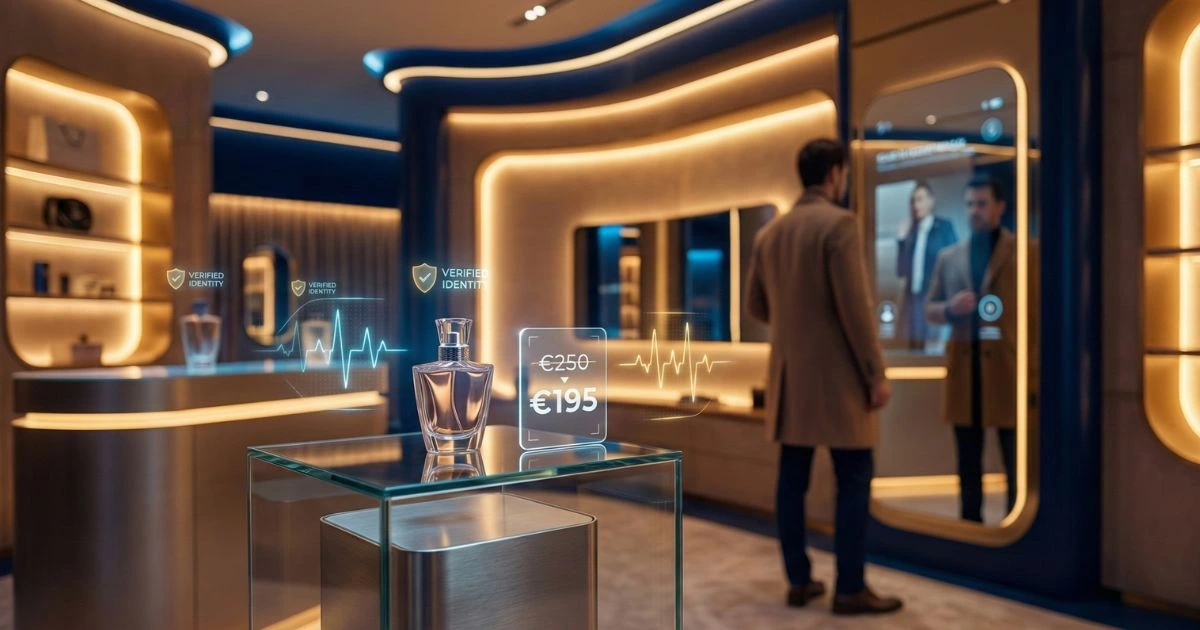
The morning air in the luxury flagship store on Regent Street felt different than it did even a year ago. There was no aggressive sales pitch, no hovering floor assistant, just a quiet, almost eerie sense of being understood. As I walked past a curated display of artisanal leather bags, my pulse quickened slightly. It was a subtle physiological response, one I barely noticed myself. But the digital ink on the price tag noticed. The numbers flickered, shifting from a standard retail price to a tailored offer that seemed to scream my name. This is the reality of retail in 2026, where the very rhythm of your heart has become the most valuable data point in the room. We have moved far beyond the era of simple cookies and browsing history. Today, the store is breathing with you, and your biological reactions are setting the market rate.
Biometric Marketing has evolved into a silent conversation between the consumer and the infrastructure. It is no longer about just identifying who you are through a fingerprint or a face scan. It is about how you feel in the moment of discovery. Sensors embedded in smart mirrors and high-definition shelf cameras are now sophisticated enough to detect micro-fluctuations in heart rate and pupil dilation. If a product excites you, the price might hold firm, or perhaps it dips just enough to push you over the edge of hesitation. It is a dance of data and desire that happens in milliseconds. For the investor and the entrepreneur, this shift represents a frontier that is as lucrative as it is ethically complex. We are seeing the birth of a marketplace where value is no longer fixed but fluid, reacting to the rawest human signals available.
The Invisible Pulse of Biometric Marketing and AI Retail 2026
The integration of these systems into the physical retail space is transforming the brick and mortar experience into something that feels like a physical extension of a high-speed algorithm. When we look at AI retail 2026, the focus has shifted from managing inventory to managing emotional states. I remember talking to a developer who described the store as a living organism. He explained that by monitoring heart rates, a store can determine the exact “stress point” of a purchase. If your heart rate spikes in a way that suggests anxiety over a price, the AI might trigger a real-time discount code sent directly to your glasses or smartphone. Conversely, if your biometrics suggest a high level of calm and “purchase readiness,” the system recognizes that your price sensitivity is low.
This level of precision is staggering. It allows for a level of margin optimization that was previously the stuff of science fiction. In the finance sector, we often talk about market efficiency, but this is efficiency taken to its logical, biological conclusion. Retailers are no longer guessing what a demographic might pay. They are seeing what an individual is willing to pay, right now, based on their central nervous system. It makes the old way of running a business—setting a price and hoping for the best—look like a relics of a primitive age. The shops that have successfully made this transition are seeing conversion rates that defy traditional retail logic. They are not just selling products; they are capturing the peak moment of human interest.
The technology behind this involves a complex web of computer vision and infrared sensors that can pick up the thermal signature of blood flow in the face. This isn’t science fiction anymore; it is the standard setup for high-end boutiques and even some progressive grocery chains. The goal is to create a frictionless environment where the transaction feels like a natural conclusion to an emotional journey. For those of us who have spent years watching the evolution of digital storefronts, the move into the physical body feels like the final frontier. It is a deep, intimate layer of data that provides a clarity no survey or focus group could ever hope to match.
Navigating the Thin Line of Consumer Data Ethics
As we dive deeper into this bio-connected world, the conversation inevitably turns toward the shadows. Consumer data ethics has become the primary hurdle for widespread adoption, and for good reason. There is something inherently invasive about a store knowing your heart rate before you’ve even spoken to a human being. I find myself constantly weighing the convenience of a personalized, frictionless world against the nagging feeling that our last bastions of privacy—our internal physical states—are being harvested for profit. The industry is currently in a tug-of-war between those who want total transparency and those who believe the results justify the means.
Governments are beginning to catch up, with new regulations appearing that require stores to disclose when they are using biometric sensors for pricing. But as we know in the world of high-finance and tech, the law often lags behind innovation. The most successful operators are those who build trust through transparency, perhaps offering a “loyalty discount” specifically for those who opt into biometric tracking. It creates a tiered experience where privacy becomes a luxury good, or a commodity to be traded for better deals. This dynamic is fascinating from a market perspective, as it creates entirely new classes of consumer behavior and data sets that can be leveraged in ways we are only beginning to understand.
There is also the question of bias. If an algorithm is trained to read excitement or stress, does it interpret different cultures or age groups correctly? A heart rate spike in a twenty-year-old might mean something entirely different than it does in a sixty-year-old. These are the nuances that will define the next few years of retail tech. The winners in this space won’t just be the ones with the best sensors, but the ones with the most sophisticated understanding of human psychology and the ethics of data. We are building a world that is incredibly responsive, but it is also a world that requires a new kind of vigilance.
The future of retail is a pulse, a flicker of an eyelid, and a whisper of data. As we walk through these 2026 storefronts, we are being seen in a way that is both terrifying and brilliant. The opportunity for growth is immense, especially for those who can navigate the complexities of this new human-centric marketplace. It is a reminder that even in an age of total automation, the most important element remains the human heart—even if we are currently busy trying to price it.
How we move forward from here depends on our ability to balance this newfound power with a genuine respect for the person behind the pulse. The market is shifting, the tech is ready, and the sensors are already watching. The only question left is how much of ourselves we are willing to trade for a slightly better price on a leather bag.

