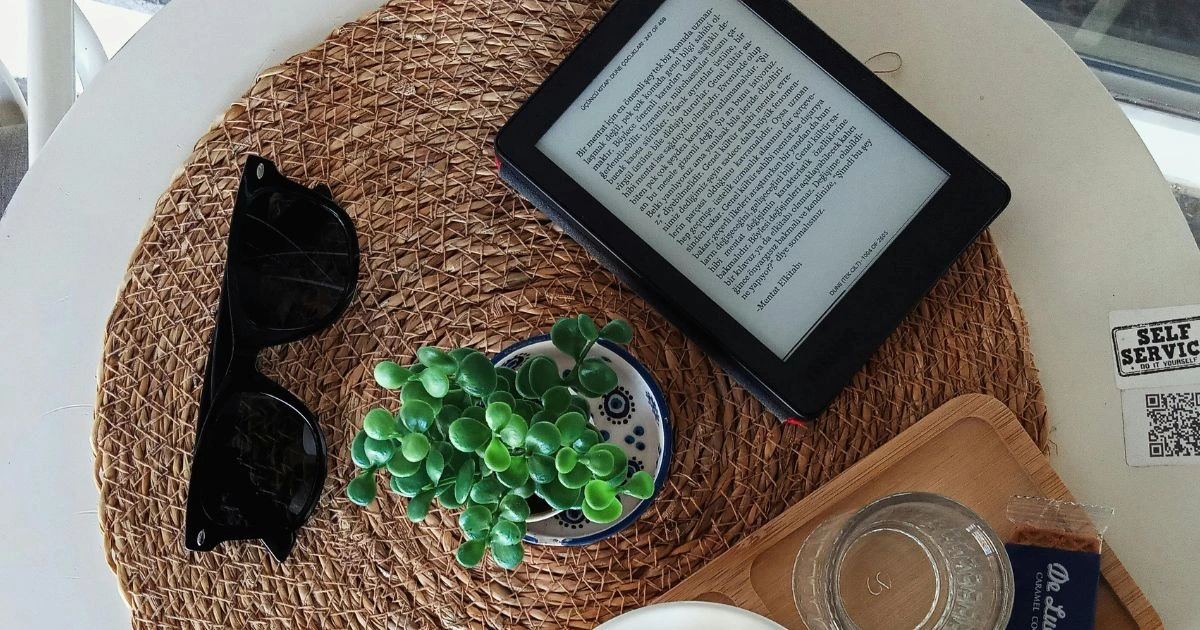
We have spent years treating the ebook like a digital photocopier. You take a manuscript, you squash it into a file format that mimics paper, and you hope the reader has enough imagination to stay awake past chapter four. But the walls are closing in on that old way of doing things. I spent a long afternoon last week sitting in a drafty coffee shop in Seattle, watching how people actually interact with their devices. Nobody is just reading anymore. They are toggling. They are listening. They are grazing. If you are still putting out flat text and wondering why your Kindle Edition Normalized Pages are flatlining, you are missing the shift that is currently happening under our feet.
The secret isn’t just about writing better prose. It is about acknowledging that the screen is a living thing. We are entering the era where hybrid eBook design is the only way to command a premium of a reader’s time. It is a messy, beautiful intersection where the silent page meets the whispered word.
The rise of multimedia publishing in the palm of your hand
I remember the first time I saw a book that didn’t just sit there. It felt like a betrayal of everything I knew about literature, but then I realized my ego was getting in the way of the reader’s experience. Multimedia publishing used to be a term reserved for expensive textbook conglomerates or failed experimental apps from a decade ago. Now, it is becoming the baseline for anyone who wants to survive the 2026 glut of content.
The trick is not to overwhelm. You aren’t making a film. You are creating an atmosphere. When I talk about these hybrids, I’m talking about the subtle integration of audio cues that trigger at the start of a chapter, or a map that isn’t just a static JPEG but a gateway. People want to feel like they are entering a world, not just a document. There is a specific kind of magic that happens when a reader realizes they can tap a character’s name and hear a three second voice memo of their “internal monologue” that isn’t in the main text. It makes the book feel like an artifact rather than a product.
We have reached a saturation point where “good enough” writing is everywhere. AI has seen to that. What the machines can’t easily replicate yet is the curated, sensory experience of a book that knows it is digital. We’ve spent so much time trying to make ebooks look like physical paper that we forgot they can do things paper never could. It’s almost a form of creative cowardice. We are holding onto the ghost of Gutenberg when we have a supercomputer in our pockets.
There is a psychological hook in these hybrid models. When you give a reader something to listen to or a small, interactive element to engage with, you reset their attention span. It’s like a palate cleanser between courses. I’ve noticed that when I incorporate these elements, the “drop off” point in my analytics shifts significantly further down the line. They stay because they are curious about what the next chapter sounds like, or what the next visual layer might reveal.
Why interactive Kindle books are winning the attention war
The data doesn’t lie, even if it feels a bit cold to talk about art in terms of retention rates. If you want to double your page reads, you have to stop thinking of a book as a linear path and start thinking of it as an environment. Interactive Kindle books are not about gimmicks. They are about depth. Imagine a non-fiction book where the charts aren’t just blurry images but something the reader can actually engage with, or a thriller where the “evidence” is a separate audio file embedded within the narrative.
This shift requires a change in how we think about the craft itself. You aren’t just an author anymore; you are a sort of director. You have to decide where the silence is more powerful than the sound, and where a visual should take over from a description. It is a delicate balance. If you do too much, you’re making a video game. If you do too little, you’re just another name in a crowded store.
I think about the landscape of self-publishing today and it feels like a gold rush where everyone is digging in the same exhausted vein. The winners are the ones looking at the technology and asking what it actually allows for. The Kindle platform has evolved, and while the e-ink purists might moan, the majority of your readers are on tablets and phones. They have color. They have high-fidelity sound. They have a restless thumb that wants to do something other than swipe left.
I was talking to a friend who lives near the tech hubs in California, and she mentioned that the most successful indie releases she’s seeing lately are the ones that lean into this hybridity. They aren’t trying to compete with Netflix; they are trying to offer something Netflix can’t provide: the intimacy of a book combined with the immersion of a soundtrack. It’s a specific niche of the human brain that lights up when these two things collide.
There is also the matter of perceived value. If a reader sees that a book is a “Hybrid,” they are often more willing to pay a higher price point or, more importantly, they are more likely to recommend it to a friend because it feels like a “thing” they found, a secret they need to share. Word of mouth is fueled by novelty. “You have to read this” is a good recommendation. “You have to experience this book” is a much better one.
We are still in the early days of this. The tools are getting easier to use, but the vision is still rare. Most people are lazy. They will continue to upload their Word documents to KDP and wonder why their career isn’t moving. But for those willing to get their hands dirty with the architecture of the file, the rewards are there. It is about building a bridge between the old world of storytelling and the new world of sensory input.
I don’t know if this is the “final” form of the book. Probably not. Everything is a transition. But right now, in 2026, the gap between the top 1% of earners and everyone else is defined by who is willing to treat the digital page as a canvas rather than a cage. It’s about being brave enough to let the audio speak when the words shouldn’t, and letting the reader play a part in the unfolding of the story.
The beauty of it is that there are no rules yet. No one has written the “manual” on how to do this perfectly. We are all just experimenting in the dark, seeing what sticks. And honestly, that’s the most exciting place to be. It’s the closest thing to the wild west we’ve had in publishing since the original Kindle launched. If you’re waiting for a sign to change your approach, look at your own phone. Look at how you consume information. The mirror doesn’t lie.
FAQ
A hybrid eBook is a digital publication that blends traditional text with integrated audio, video, or interactive elements designed to enhance the narrative flow.
While e-ink devices have limitations, many hybrid features are designed to degrade gracefully into static images or text, while fully shining on the Kindle app for tablets and phones.
Yes, because the audio is supplemental and contextual, often acting as “bonus content” or atmospheric soundscapes rather than a straight narration of the text.
By providing a more engaging, multi-sensory experience, readers are less likely to get bored and more likely to finish the book, which naturally increases the total pages read.
Not necessarily, as many new publishing tools allow for drag-and-drop integration of multimedia, though a basic understanding of file structures helps.
It can be, but many authors are finding creative ways to produce audio and visuals on a budget using accessible digital tools.
Yes, there are delivery fees based on file size, so it is crucial to optimize your audio and images to keep the file lean.
If done poorly, yes. The goal is for the multimedia to support the prose, not replace or overshadow it.
Absolutely, you can update your manuscript and re-upload the file to KDP to give your backlist a second life.
Trends show a growing preference for “immersive” content, especially among younger demographics who are used to multi-modal information.
Ambient soundscapes, character voice-notes, or short musical themes for specific locations within the story.
Usually, the “Look Inside” only shows text, so you should mention the hybrid features in your book description to alert potential buyers.
The Kindle app supports limited video, but it is often better to use high-quality GIFs or links to external unlisted videos to keep the file size manageable.
Focus on the “experience” rather than just the plot. Use video trailers that showcase the interactive elements.
Yes, once the file is downloaded, the embedded media usually works without an active internet connection.
While popular in non-fiction and sci-fi, even romance and literary fiction can benefit from atmospheric audio or visual character “extras.”
Over-complicating the interface. If the reader can’t figure out how to “play” the book, they will just close it.
Amazon is the leader, but Apple Books actually has even more robust support for interactive ePub files.
You must ensure you own the rights to any media you embed, just as you do with the text and cover art.
Unlikely. There will always be a market for pure text, but hybrids are becoming a powerful premium alternative.
Start small. Add one audio “director’s commentary” at the end of a chapter and see how your readers respond.