
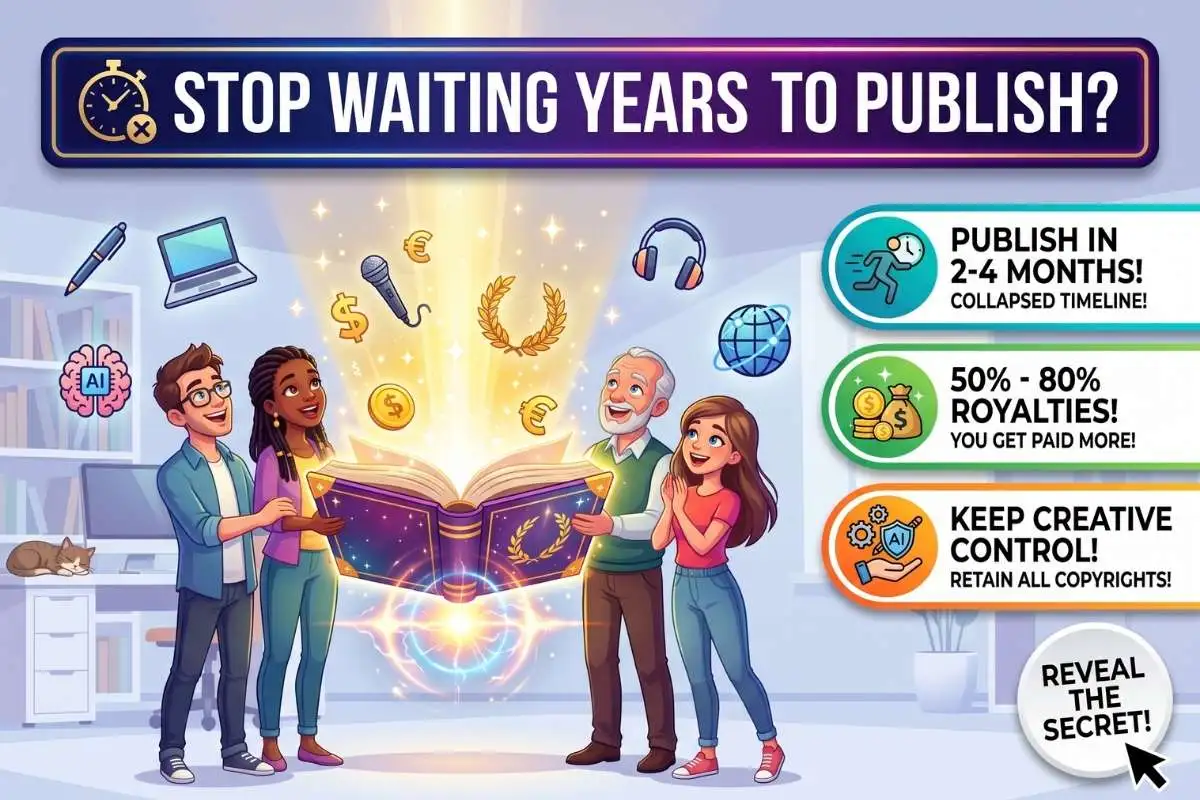
Picture a dedicated writer sitting at their kitchen table in 2026, staring intently at a completed manuscript. For generations, authors at this exact juncture faced a rigid, frustrating crossroads: spend years begging traditional publishing gatekeepers in New York for validation, or venture into self-publishing and juggle freelance editors, formatters, and complex retail algorithms entirely alone. Today, however, the literary landscape has redrawn itself around a pragmatic middle path. Enter AI-assisted hybrid publishing—a rapidly expanding model that pairs the creative autonomy and speed of indie publishing with the distribution infrastructure and editorial rigor of legacy presses. Powered by sophisticated backend artificial intelligence, this middle ground is quietly democratizing authorship. Here is how modern writers are leveraging intelligent workflows to achieve commercial success without sacrificing their authentic storytelling voice.
The Collapse of Production Timelines
Historically, transforming a raw literary concept into a physical book on a retail shelf required extraordinary patience. A standard traditional publishing cycle routinely consumed eighteen to twenty-four months—time spent languishing in sluggish editorial queues, manual typesetting passes, and complex physical warehousing logistics. Today, intelligent workflow technology has collapsed that daunting timeline by nearly ninety percent. In the modern hybrid publishing ecosystem, artificial intelligence functions as an invisible, high-speed engine room. Rather than replacing human creativity, advanced language models eliminate the mechanical friction of manuscript production. Partner presses deploy specialized AI software to perform automated developmental consistency checks across complex series, flag factual discrepancies in non-fiction drafts, and generate precise descriptive metadata in seconds. By accelerating routine copyediting against strict house style guides, reputable hybrid presses can now transform a completed draft into a polished, market-ready publication in just a few weeks, enabling writers to capture fast-moving cultural moments.
Shifting Economics and Authorial Control
The true appeal of this emerging middle ground lies in its equitable financial structure and staunch defense of authorial autonomy. In legacy contracts, writers routinely surrender their intellectual property rights and creative control in exchange for modest upfront advances and standard royalty splits that rarely surpass fifteen percent. Conversely, independent self-publishing removes corporate gatekeepers but places the entire operational burden directly onto the writer. As documented in foundational publishing resources like Wikipedia’s comprehensive overview of self-publishing, independent authors historically had to fund interior formatting, proofreading, and cover design out of pocket. Modern AI-assisted hybrid publishers bridge this divide through a collaborative co-investment model. While authors contribute to preliminary production costs, AI automation has lowered those baseline operational expenses significantly. Because partner presses spend less capital on manual typesetting and structural line editing, they pass those savings directly to authors through generous royalty percentages ranging from fifty to eighty percent while allowing writers to retain full copyright ownership.
Algorithmic Discovery and Omni-Channel Reach
Even the most masterfully composed book will struggle to find buyers if targeted readers never realize it exists. In earlier decades, commercial visibility depended heavily on physical bookstore placement dictated by centralized retail buyers. In 2026, book discovery is driven by decentralized search algorithms, hyper-targeted social media subcultures, and personalized AI recommendation engines. Modern hybrid publishing houses harness predictive data analytics to study reader browsing behavior, genre volume, and keyword demand long before a manuscript goes to press. By feeding narrative themes into automated categorization tools, publishers optimize digital tags across global digital storefronts. Furthermore, rather than relying exclusively on a single platform, modern hybrid models utilize automated multi-format conversion pipelines to release simultaneous ebook, print-on-demand paperback, and AI-narrated audiobook editions. This omni-channel distribution strategy guarantees that whether a reader discovers a book through a viral TikTok review or an algorithmic subscription feed, the title is immediately accessible.
Preserving the Irreplaceable Human Core
Despite the widespread integration of artificial intelligence across production pipelines, the publishing industry has embraced a vital realization by 2026: technology cannot synthesize authentic human empathy. When generative AI models first flooded online platforms several years ago, readers quickly experienced fatigue from generic prose, repetitive phrasing, and formulaic narrative structures. As highlighted in established publishing records such as Wikipedia’s overview of hybrid publishing, readers ultimately seek genuine emotional resonance, original research, and compelling lived experiences. The most successful hybrid publishing houses today enforce a strict division between machine efficiency and human creativity. Artificial intelligence manages routine formatting, layout consistency, and preliminary grammar checks, which frees professional human editors to focus entirely on substantive developmental guidance. The author’s unique prose, personal vulnerability, and moral perspective remain the irreplaceable soul of the manuscript. In this balanced model, artificial intelligence operates strictly as a productivity multiplier rather than a creative substitute.
Navigating these trade-offs requires clear financial planning. The interactive explorer below lets you model upfront investment, time-to-market, and author earnings across all three publishing models based on your personal budget.
As the tool illustrates, hybrid publishing frequently provides the optimal financial balance for authors seeking professional standards without forfeiting long-term royalty revenue.
Comparing Publishing Paths at a Glance
To summarize how these operational structures compare across the industry, the data table below outlines core benchmarks for upfront investment, production speed, and author control in 2026.
| Feature | Traditional Publishing | AI-Assisted Hybrid Publishing | Pure Self-Publishing |
| Upfront Cost | $0 (Funded by publisher) | Moderate author co-investment | Variable (Author funds all) |
| Time to Market | 18 to 24 months | 2 to 4 months | 1 to 3 months |
| Royalty Share | 8% to 15% of net sales | 50% to 80% of net sales | ~70% (minus retail fees) |
| Creative Control | Low (Publisher holds final say) | High (Shared collaborative decision) | Complete (Author holds all rights) |
| Primary AI Role | Internal backend editorial checks | End-to-end workflow acceleration | Direct author prompt generation |
Ultimately, authors must decide whether corporate prestige outweighs the rapid market entry and higher royalty margins delivered by hybrid partner models.
Frequently Asked Questions
Q: Does artificial intelligence actually write the books published through hybrid presses in 2026?
A: Absolutely not. Reputable hybrid publishing houses maintain strict editorial standards that expressly prohibit fully AI-generated manuscripts. While modern authors and editors routinely utilize advanced artificial intelligence tools to outline plot structures, catch grammatical inconsistencies, verify citation formatting, and analyze target keyword trends, the substantive prose and original thought leadership must originate from a human writer. Readers easily detect artificial writing, and books lacking genuine human emotion consistently fail to find a lasting commercial audience.
Q: How can an author distinguish a reputable hybrid publisher from a predatory vanity press?
A: The primary difference lies in editorial selectivity and financial alignment. A legitimate hybrid publisher vets incoming submissions rigorously and rejects manuscripts that fail to meet professional quality benchmarks. Furthermore, reputable partner presses provide clear, transparent contracts offering high royalty splits (typically between fifty and eighty percent) and detailed breakdowns of how your co-investment funds editing, cover design, and verified book distribution. Conversely, predatory vanity presses accept virtually any manuscript as long as the author pays, offering zero meaningful editorial guidance or bookstore distribution.
Q: Why is print-on-demand technology so critical to the success of modern hybrid publishing?
A: Print-on-demand (POD) eliminates the massive upfront capital risk and warehousing costs historically associated with traditional offset book printing. AI-automated layout software prepares flawless digital print files that are transmitted directly to regional printing facilities whenever a reader purchases a physical copy. This sustainable infrastructure allows hybrid authors to sell professional paperback and hardcover editions globally without manufacturing thousands of speculative copies that might end up pulped or unsold.
Summary: The Literary Landscape Ahead
As we look toward the future of book publishing, the ideological war between legacy gatekeepers and independent purists is fading into irrelevance. Readers browsing local bookstore aisles or swiping through digital e-readers rarely check the publishing imprint on a copyright page; they care solely about whether a story captivates their imagination or transforms their perspective. AI-assisted hybrid publishing has forged a highly effective middle path. By eliminating administrative delays and lowering financial barriers, this modern framework allows writers to operate with the entrepreneurial agility of an indie author while retaining the professional polish of a traditional release. The curiosity that drives human beings to tell stories has remained unchanged for millennia. What has evolved is our unprecedented ability to share those stories across the globe—faster, fairer, and more creatively than ever before.
