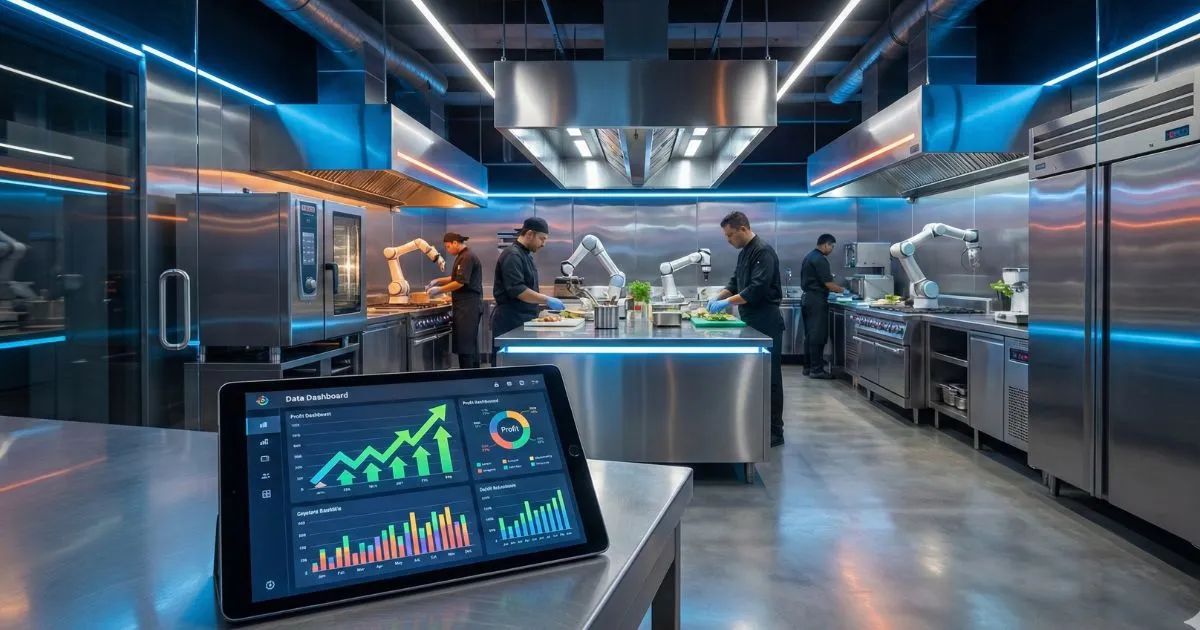
I remember sitting in a dimly lit bistro in Manhattan about five years ago, watching a server struggle with a paper ticket while three different delivery tablets chimed like a slot machine gone rogue. It was chaotic, loud, and frankly, a financial disaster in the making. Fast forward to February 2026, and the landscape of the food industry 2026 has shifted so violently that the very concept of a “restaurant” is being rewritten by lines of code and windowless industrial units. We are no longer talking about mere delivery apps. We are witnessing the rise of the machine-managed culinary ecosystem, where AI Ghost Kitchens are quietly dismantling the traditional overhead-heavy model that has kept restaurant margins razor-thin for decades.
It is a strange time to be an investor, or even just a hungry person with a smartphone. You might order a spicy tuna bowl from a brand that exists only on your screen, unaware that the recipe was optimized by a neural network to minimize waste and that the prep time was calculated to the microsecond by a predictive dispatch algorithm. There is a certain clinical beauty to it. The friction of the human element—the front-of-house staff, the expensive street-level real estate, the unpredictability of foot traffic—has been engineered out of the equation. In its place is a lean, data-driven machine that treats a chicken sandwich less like a meal and more like a high-velocity asset.
Building Wealth Through High Margin Restaurant Tech
The shift toward these automated hubs isn’t just about convenience. It is about the cold, hard math of survival in an era of skyrocketing labor costs and volatile supply chains. If you look at the balance sheet of a traditional eatery today, you see a graveyard of fixed costs. Rent for a prime corner spot can eat 10% of gross sales before the first burner is even lit. Then you have the 30% dedicated to labor. By the time you account for food spoilage and utilities, the owner is lucky to walk away with a 5% margin. AI Ghost Kitchens are flipping that script entirely. By moving operations to “dark” locations—industrial zones where rent is a fraction of retail prices—and using restaurant tech to manage inventory, these operations are pushing margins into the 15% to 25% range.
I recently spoke with an operator who runs six different virtual brands out of a single 200-square-foot pod. One hour it is a vegan burger joint, the next it is a gourmet grilled cheese spot. The AI manages the pivot, shifting the digital menu based on real-time search trends in the neighborhood. If the data shows a sudden spike in “comfort food” searches because of a rainstorm, the kitchen is ready. This level of agility is impossible for a legacy restaurant tied to a physical sign and a printed menu. For those of us looking at the digital acquisition space, this represents a fundamental change in how we value cash-flowing assets. A business is no longer defined by its four walls but by its data stack and its ability to capture a specific niche of digital demand.
The beauty of this model lies in its “plug and play” nature. We are seeing a surge in entrepreneurs who don’t even know how to flip a burger but know how to manage a digital brand. They buy the infrastructure, license the AI-optimized recipes, and let the software handle the logistics. It is essentially “SaaS-ifying” the food world. The risk is lower, the scale is faster, and the exit strategies are much cleaner. When you own a portfolio of high-performing virtual brands, you aren’t selling a kitchen; you are selling a predictable stream of digital revenue.
Scaling Virtual Brands with AI Ghost Kitchens
We have reached a maturation point where the “ghost” in the machine is becoming remarkably sophisticated. In early 2026, the integration of generative AI into the supply chain has reached a level where the kitchen knows you are hungry before you do. It isn’t just about making the food; it is about the “where” and “when” of the entire logistics chain. The disruption is coming from the ability to eliminate the “dead zones” in a kitchen’s day. Traditional restaurants have huge spikes at lunch and dinner, with staff sitting idle in between. AI Ghost Kitchens use dynamic pricing and multi-brand strategies to keep the burners hot sixteen hours a day.
This leads to a fascinating divergence in the market. On one hand, you have the “experiential” dining—the high-end, $200-a-plate places where you pay for the atmosphere and the chef’s ego. On the other hand, you have the utility of food. The latter is being swallowed whole by automation. For an investor, the utility side is where the recurring revenue lives. It is the boring, consistent, and highly scalable part of the food industry 2026. If a virtual brand is seeing a 20% month-over-month growth in a specific zip code, the operator can simply lease another pod and replicate the success in weeks, not years. No permits for outdoor seating, no liquor license hearings, no interior decorators. Just more capacity.
There is, of course, a lingering question of soul. Can an algorithm truly replace the intuition of a line cook who has been working the same station for twenty years? Probably not. But the data suggests that for a Tuesday night delivery order, the consumer prioritizes consistency and speed over “soul.” They want the fries to be crisp, the temperature to be right, and the price to be fair. AI excels at that kind of precision. It doesn’t get tired, it doesn’t call in sick, and it doesn’t forget to put the sauce on the side.
As we look toward the second half of the decade, the barrier to entry for the food business has never been lower, yet the technical requirements have never been higher. You don’t need a culinary degree to win in this space anymore; you need a sharp eye for digital assets and a willingness to embrace the automation of the everyday. The kitchens are going dark, but for those who know where to look, the future has never been brighter. We are moving into an era where the most valuable real estate isn’t on Broadway—it is on the first page of a delivery app, powered by a silent, windowless room three miles away.