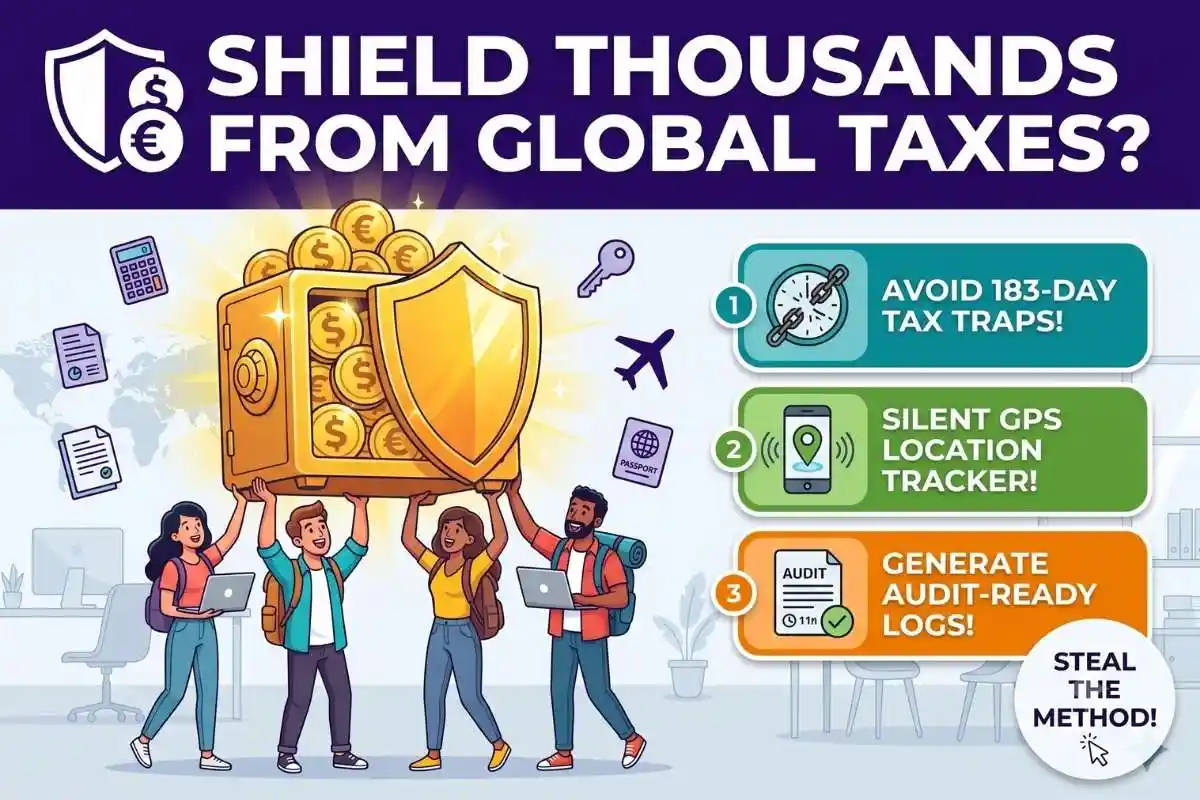
For years, the digital nomad dream was sold as a frictionless montage of laptop-lit beach sunsets in Bali, bustling coworking cafes in Lisbon, and alpine retreats in Bansko. Yet, behind the scenes of this unrestricted global freedom lies a Byzantine labyrinth of international tax laws that can turn a seamless remote career into an administrative nightmare. In 2026, global tax authorities have upgraded their oversight with automated digital surveillance, making old-school tactics like “flying under the radar” or informally hopping borders obsolete. Today, savvy remote workers no longer rely on guesswork or crumpled boarding passes to defend their financial livelihoods. Instead, they are turning to advanced compliance software and automated tracking tools. By pairing intelligent location technology with a deep understanding of global tax treaties, modern nomads are legally shielding thousands of dollars in income while sleeping soundly in whatever time zone they choose to call home.
Mastering the Invisible Boundary of the 183-Day Rule and Territorial Systems
For global remote workers, understanding how countries assert their right to tax your income is the single most important factor in building a wealth-preservation strategy. Most nations operate on a residence-based model governed by the classic 183-day rule, which dictates that spending six months inside a country’s borders automatically transforms a traveling professional into a full-fledged local tax resident. However, savvy nomads understand that modern compliance goes far beyond simply counting days on a wall calendar. Many forward-thinking jurisdictions, such as Costa Rica, Panama, and Malaysia, utilize a territorial tax system where local authorities only tax income generated from local commercial activities within their borders. If you are developing software for a client in Seattle or consulting for a firm in Berlin while physically living in a territorial tax hub, your foreign-sourced income may legally be exempt from local taxation. Navigating these nuanced frameworks requires continuous attention to detail, as tax agencies increasingly scrutinize whether your economic presence and personal ties constitute a permanent home. By mastering the distinction between residence-based and territorial jurisdictions, remote workers can strategically align their travel schedules to maximize legal deductions without triggering accidental residency in high-tax regions. Anyone seeking to dive deeper into how different nations structure these cross-border frameworks can explore the foundational principles of international taxation outlined on Wikipedia, which details the mechanics of worldwide versus territorial systems.
The Rise of Automated Geofencing and Background Residency Trackers
In the past, proving your exact location on any given day required a tedious paper trail of passport stamps, airline receipts, and credit card statements. In 2026, automated compliance software has completely revolutionized how digital nomads maintain their statutory records. Modern residency tracking applications run silently in the background of smartphones, utilizing encrypted GPS geofencing and mobile tower triangulation to log exact daily coordinates without sacrificing user privacy. These applications continuously reconcile your travel history against local statutory residency thresholds, sending real-time push notifications the moment you approach a critical cutoff day. For American expatriates and global citizens alike, precise day-counting software is the ultimate defense during high-stakes tax audits. Under strict definitions, a single overlapping hour spent waiting for a connecting flight or crossing a border at midnight can legally qualify as a full day of physical presence within a jurisdiction. Automated platforms eliminate human error by generating immutable, timestamped audit logs that clearly separate transit hours from overnight stays. By replacing spreadsheet guesswork with verifiable software logs, remote professionals can confidently prove their non-resident status to foreign governments and domestic tax boards, saving countless hours and preventing devastating assessment penalties.
Navigating Automated Data Exchange and the Physical Presence Test
The era of digital invisibility has officially closed with the global rollout of automated financial data-sharing treaties, including the Common Reporting Standard (CRS) and the Crypto-Asset Reporting Framework (CARF). In 2026, banks, fintech platforms, and virtual card providers routinely share transaction histories across international jurisdictions. This heightened transparency means that spending patterns are no longer isolated; if you swipe a debit card at a cafe in Madrid for four consecutive months, tax algorithms can flag that activity as potential unrecorded residency. To operate safely within this hyper-transparent environment, remote workers must establish airtight compliance habits that withstand automated scrutiny. For United States citizens—who are uniquely taxed on their global income regardless of where they reside—this compliance infrastructure is particularly vital for securing the Foreign Earned Income Exclusion (FEIE). To legally exclude up to six figures of foreign-earned income from federal income taxes, travelers must satisfy strict presence metrics. You can verify the exact eligibility criteria directly through the Internal Revenue Service guidelines on the physical presence test, which mandates that individuals must be physically present in a foreign country or countries for at least 330 full days during any consecutive 12-month period. Specialized compliance software simplifies this demanding rule by calculating rolling 12-month windows automatically, identifying optimal exclusion periods and protecting significant wealth from double taxation.
Strategic Entity Segregation and the Rise of Digital Nomad Visas
Beyond personal day-counting apps, the most sophisticated 2026 digital nomads utilize corporate restructuring software to separate their physical presence from their business nexus. Establishing an online corporate entity in a business-friendly jurisdiction—such as Estonia’s e-Residency ecosystem or Bulgaria’s low-tax framework—creates a legal shield that insulates business revenue from personal travel habits. When paired with formal Digital Nomad Visas (DNVs) offered by countries like Spain, Greece, and Malta, remote professionals obtain explicitly defined legal classifications that clarify their tax obligations from day one. Compliance platforms now integrate corporate accounting tools directly with immigration tracking, helping freelancers automatically calculate appropriate payroll distributions and social security contributions across borders. This holistic approach ensures that digital nomads do not inadvertently trigger a “Permanent Establishment” for their employer or personal agency in a host nation. By formalizing their global footprint through dedicated nomad visas and clean corporate separation, remote workers achieve peace of mind, seamless banking access, and a transparent, professional status that satisfies both clients and international revenue authorities.
2026 Global Nomad Tax & Compliance Landscape
To evaluate how different destinations and software strategies compare across the globe, consider the structural breakdowns in the table below. Selecting the right combination of residence rules and compliance monitoring is essential for optimizing your annual earnings.
| Jurisdiction / Strategy | Primary Tax Mechanism | Typical Residency Threshold | Key 2026 Compliance Advantage |
| Territorial Hubs (e.g., Costa Rica, Panama) | Local-source income taxed; foreign income exempt | 183 days within a calendar year | Complete exemption on remote overseas earnings when properly documented |
| U.S. Expat Strategy (FEIE Physical Presence) | Worldwide taxation with major exclusion allowances | 330 full days abroad in a rolling 12-month period | Excludes over $130,000 of earned income from U.S. federal income tax |
| European DNV Hubs (e.g., Spain, Greece) | Special reduced nomad rates or flat income regimes | Visas typically valid for 1–3 years | Clear legal status preventing accidental double taxation under bilateral treaties |
| Automated Tracker Apps (e.g., TaxBird, Domicile365) | Real-time GPS & background geofencing software | Custom alerts set at 60, 90, or 183 days | Generates audit-ready timestamped reports to refute improper assessment claims |
Frequently Asked Questions (FAQ)
Can I legally pay zero income tax as a digital nomad in 2026?
While it is technically possible to achieve a zero-tax footprint, doing so requires meticulous legal structuring rather than simply traveling non-stop. Nomads typically accomplish this by establishing their permanent tax home in a zero-tax jurisdiction (like the United Arab Emirates) or a territorial tax country while ensuring they do not trigger statutory tax residency in any high-tax nation they visit. However, you must maintain exhaustive location records using compliance apps to prove you haven’t overstayed residence thresholds anywhere else.
How do tax authorities know how long I have been in their country?
Authorities no longer rely solely on physical border checks or passport stamps. In 2026, immigration databases are digitized and linked across regions like the European Union’s Schengen Area. Additionally, international banking treaties force financial institutions to report transaction data, meaning that regular ATM withdrawals, rideshare app usage, and local accommodation bookings create an unmistakable digital footprint that tax agencies can analyze.
What is the difference between a tax resident and a tourist?
A tourist visits a country temporarily for leisure without integrating into the local economy, usually staying under standard 90-day tourist visa limits. A tax resident is recognized under domestic law as having established a primary legal presence, triggered either by spending more than a set number of days (usually 183) or by shifting their “center of vital interests,” such as purchasing a home, enrolling children in school, or managing primary business operations within the borders. To explore how different countries define and enforce these distinct personal statuses, review the global overview of tax residence criteria explained on Wikipedia.
Do automated residency tracking apps drain my phone battery or violate my privacy?
Modern compliance software is built specifically to operate efficiently in the background, utilizing low-power cell tower pings and significant motion changes rather than constant high-drain GPS polling. Reputable tax compliance tools use bank-grade encryption and store location logs locally or in private, siloed cloud vaults, ensuring your data is only compiled into audit reports when you explicitly choose to export it for your accountant or tax authorities.
The Curiosity Summary: The Digital Nomad’s Tax Toolkit
As remote work transitions from a temporary trend into a permanent lifestyle, the romantic notion of living completely off the grid has given way to smart, proactive digital governance. The most successful nomads of 2026 are not hiding from international authorities; they are leveraging automated compliance tech to play the game by the book and win. By combining continuous background location tracking with strategic corporate structuring and territorial tax planning, today’s location-independent workers turn complex regulations into a powerful financial advantage. Ultimately, the best tax loophole isn’t secrecy—it is verifiable precision, giving you the freedom to explore the planet while keeping your hard-earned wealth secure.