
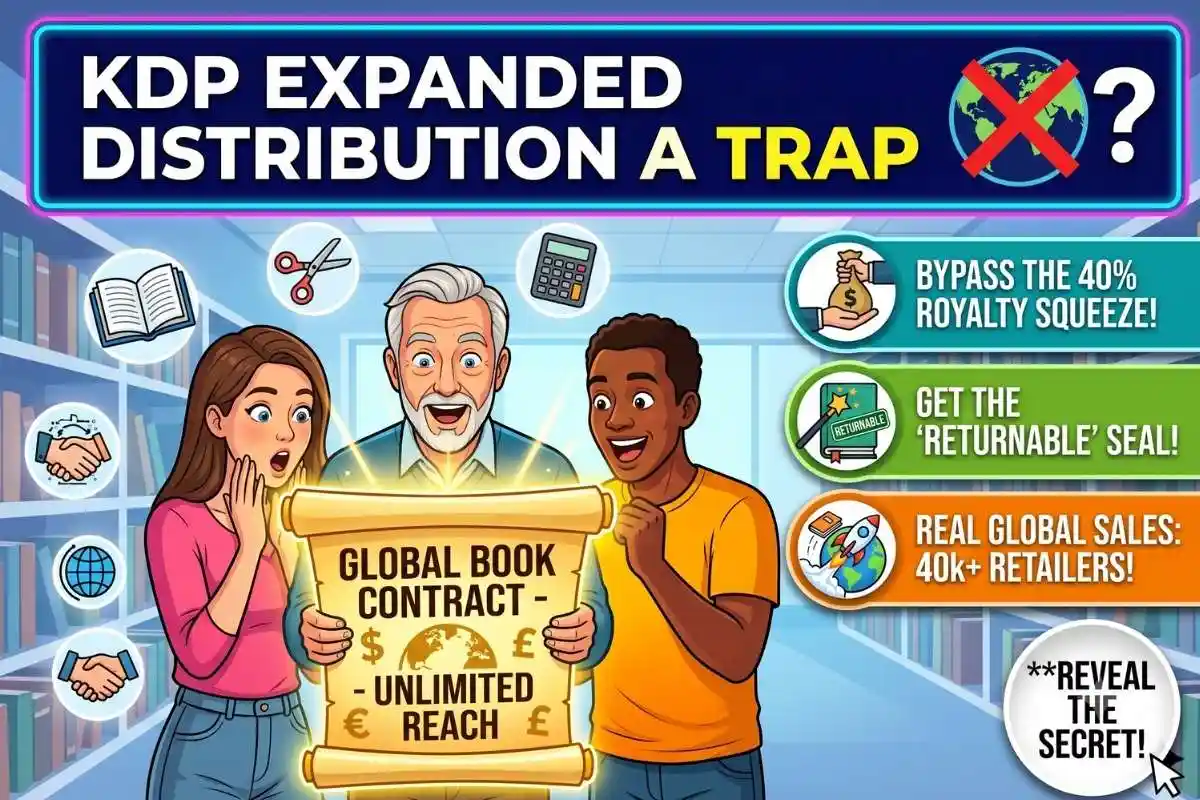
Imagine this scenario: you spend months pouring your heart into a manuscript, perfecting the formatting, and designing a stunning book cover. You successfully publish your paperback on Amazon’s Kindle Direct Publishing (KDP) platform. To maximize your reach, you enthusiastically check the box for “Expanded Distribution,” dreaming of your book hitting local bookstore shelves and finding readers across Europe, Australia, and beyond. Yet, months pass, and your international sales dashboard remains frustratingly at zero. You are left wondering why global readers are completely ignoring your work despite your best efforts.
The Illusion of Global Reach Through Amazon
The hard truth is that checking the Expanded Distribution option does not magically place your book in storefronts worldwide. While KDP is a massive global powerhouse, its Expanded Distribution program is fundamentally misunderstood by many self-published authors. Amazon explicitly states that this program is designed to make paperbacks available to large distributors so that physical bookstores, online retailers, and academic libraries can order them. However, availability does not equal active distribution or marketing. Most brick-and-mortar bookstores operate on returnable inventory models, meaning they rarely order non-returnable print-on-demand books unless a customer explicitly walks to the counter and requests a specific title.
Furthermore, the geographical scope of this program is surprisingly restrictive compared to standard Amazon marketplace distribution. Many indie authors assume that an expanded reach means their paperback will automatically cascade into every international online retailer. In reality, Amazon currently limits the primary distributor networks for this program to specific regions, primarily focusing on the United States and the United Kingdom. While international vendors can theoretically purchase from these wholesale feeds, systemic barriers like high foreign exchange rates, prohibitive cross-border shipping costs, and algorithmic de-prioritization usually prevent global retailers from actually listing or stocking your paperback.
Strict Eligibility and Formatting Roadblocks
Even if international retailers were eager to catalog your book, KDP imposes strict technical requirements that routinely disqualify paperbacks from entering the broader distribution network. First and foremost, physical dimensions matter immensely. Amazon only allows specific, industry-standard trim sizes—such as 6 x 9 inches or 5.5 x 8.5 inches—to qualify for Expanded Distribution. If you choose a custom trim size or popular square formats often used for children’s literature, the system will automatically block your book from leaving the standard Amazon ecosystem. You can verify these strict publishing guidelines directly on the Amazon KDP Help Center.
Beyond physical dimensions, paper type and content classification act as major gatekeepers. Hardcover books, for instance, are completely ineligible for KDP’s Expanded Distribution program. Similarly, if your book requires premium color ink or falls under low-content categories like journals, planners, and coloring books, distributors will flatly reject it. Amazon also excludes books written in certain languages, including Japanese and Hebrew, from this program. If your paperback triggers any of these formatting or content rules, your international sales potential through third-party networks is effectively dead on arrival, regardless of how many times you update your listing.
The Royalty Squeeze and Pricing Paradox
Perhaps the most discouraging hurdle for authors trying to sell paperbacks internationally via KDP is the brutal economics of wholesale pricing. When you sell a paperback directly through a standard Amazon marketplace, you receive a 60% royalty rate minus the printing costs. However, when a sale occurs through Expanded Distribution, your royalty rate drops drastically to just 40% minus those same printing costs. Why the massive reduction? That missing 20% goes toward paying the external wholesale middlemen and the third-party retailers who ultimately facilitate the sale to the end consumer.
This reduced royalty structure forces authors into a frustrating pricing paradox, especially when converting currencies for international markets. To earn even a meager profit margin of one dollar on a long paperback enrolled in Expanded Distribution, you must artificially inflate your retail list price. Consequently, your book ends up priced significantly higher than traditionally published competitors sitting on the same international digital shelf. Overseas readers browsing third-party bookstore websites are quickly scared off by these inflated price tags, which are often compounded by local Value Added Tax (VAT) and international shipping tariffs.
Better Strategic Alternatives for Going Wide
If your goal is genuine international paperback distribution, relying solely on Amazon’s in-house infrastructure is a flawed strategy. Experienced independent authors generally recommend a hybrid distribution model to truly capture global markets. The industry standard approach involves publishing directly through Amazon KDP to service customers shopping on native Amazon marketplaces, while simultaneously utilizing a dedicated wholesale distributor like IngramSpark for everything else. IngramSpark feeds directly into the global book supply chain, offering customizable wholesale discounts and the crucial “returnable” status that traditional bookstores require.
By separating your distribution channels, you retain the high profit margins of direct Amazon sales while systematically removing the barriers keeping your paperback out of foreign markets. You can learn more about international trade and global distribution standards by exploring resources provided by the International Trade Administration. Taking control of your book’s metadata and distribution rights allows you to compete on a level playing field globally. Authors who step outside the KDP-only ecosystem routinely see a noticeable uptick in international visibility, institutional library orders, and sustained paperback sales.
KDP vs. Dedicated Wholesale Distribution
| Feature | KDP Standard Distribution | KDP Expanded Distribution | Dedicated Wholesale (e.g., IngramSpark) |
| Primary Markets | Amazon marketplaces worldwide | Select US/UK wholesale networks | Global 40,000+ retailers & libraries |
| Royalty Rate | 60% (minus printing costs) | 40% (minus printing costs) | Author-controlled (typically 40%–60%) |
| Returnable Status | No | No | Yes (Optional, required by bookstores) |
| Trim Size Limits | Accepts custom & standard sizes | Strict standard sizes only | Broad range of industry standards |
| Hardcover Eligibility | Yes | No | Yes |
Frequently Asked Questions
Does enrolling in Expanded Distribution cost extra money?
No, checking the Expanded Distribution option in your KDP dashboard is completely free. However, the indirect cost comes in the form of a significantly reduced royalty rate (40% instead of 60%) when a sale is made through this channel.
How long does it take for my book to appear in international third-party stores?
Once you enable Expanded Distribution, it can take anywhere from six to eight weeks for external distributors and booksellers to update their systems and list your book. Even then, listing is not guaranteed.
Can I use my own ISBN for KDP Expanded Distribution?
Yes, you can use either a free KDP-assigned ISBN or your own purchased ISBN. However, to qualify, your ISBN must not have already been submitted for distribution through another competing service like IngramSpark.
Why is my book marked as ‘Ineligible’ for Expanded Distribution on my dashboard?
Your book likely violates one of KDP’s physical or content rules. Common culprits include using a non-standard trim size, selecting premium color ink, publishing a hardcover format, or selling low-content books like journals.
The Curiosity Corner: Did You Know?
Did you know that physical bookstores almost never buy print-on-demand books unless they can return them for a refund if they don’t sell? This industry-standard practice is called “sale or return.” Because Amazon KDP strictly refuses to accept paperback returns from retailers, local bookshops around the world almost universally filter out KDP-printed ISBNs from their purchasing catalogs. So, while your book might technically exist in a digital wholesale catalog, a bookstore owner’s system will often flash a warning advising them not to order your paperback for shelf stock!
To deeper understand the changing landscape of self-publishing distribution rules and how to navigate around KDP’s limitations, watch this detailed explanation: Why Amazon KDP Is Almost Impossible In 2026. This video provides relevant visual context on modern publishing strategies and explains why relying solely on traditional KDP distribution tactics often stalls author sales in current markets.
