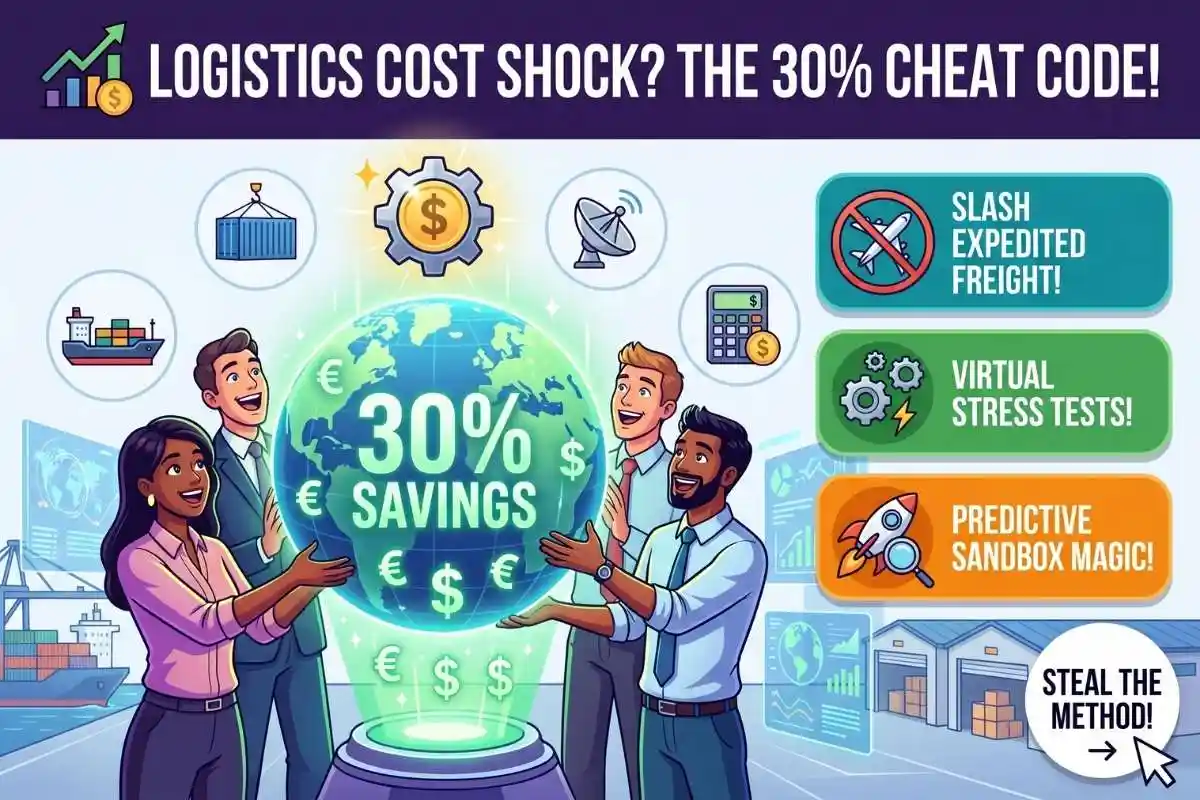
Imagine being able to crash a massive cargo ship into a simulated port, trigger a sudden 50% tariff hike on electronics overnight, or shut down a primary trucking corridor—all without losing a single real-world dollar. In 2026, corporate logistics has completely shifted away from frantic reactive firefighting into the realm of high-fidelity virtual sandboxes. Welcome to the era of the B2B supply chain digital twin. By creating living, breathing software replicas of their entire global movement networks, major corporations are performing virtual stress tests that predict bottlenecks weeks before they happen. This isn’t just an incremental technological upgrade; it is a profound operational cheat code. Across global manufacturing, retail, and automotive sectors, this single simulation trick is actively slashing enterprise logistics expenses by a staggering 30%, transforming how the physical world gets delivered.
From Static Maps to Living Replicas
For decades, supply chain managers relied on static spreadsheets, historical averages, and delayed reporting tools that offered little more than a rearview mirror of what had already gone wrong. Today, a true digital twin represents a monumental leap forward, operating as a dynamic, real-time mirror of a company’s physical ecosystem. First conceptualized by engineers working with NASA to monitor distant spacecraft from afar, the underlying architecture has fully matured into the commercial logistics sector. Modern digital twins continuously ingest live data streams from Internet of Things (IoT) cargo sensors, automated warehouse platforms, satellite tracking, and supplier inventory portals. Instead of guessing where a container ship might be or when raw lithium will arrive at a factory, operational teams watch a synchronized virtual model update second by second, predicting bottlenecks before they happen.
The Power of Predictive Sandboxes
The magic of the 2026 digital twin lies in its ability to transition a business from merely diagnosing past failures to predicting and prescribing future triumphs. According to comprehensive documentation on Wikipedia, virtual representations allow complex systems to run thousands of simulation scenarios in a completely risk-free sandbox. Modern platforms utilize advanced machine learning algorithms to project network conditions months into the future. Instead of delivering a rigid point estimate that breeds false precision, predictive twins generate nuanced probability ranges—warning operators, for instance, that there is a 75% chance a specific cross-border rail link will suffer severe congestion next week. When paired with prescriptive AI, the software actively generates ranked, cost-evaluated solutions, such as rerouting bulk shipments through an alternative port.
Deconstructing the 30% Cost Reduction
How exactly does pushing pixels in a virtual simulation translate into a massive 30% reduction in corporate logistics expenses? The savings materialize by systematically eliminating the three most expensive hidden penalties in global trade: emergency expedited freight, excessive buffer inventory, and unplanned facility downtime. Historically, when a tier-two supplier encountered an unannounced production halt, manufacturers were forced to charter emergency air cargo flights at astronomical rates. Digital twins eliminate this panic by providing multi-tier visibility that flags material shortages early enough to secure standard, economical ocean or rail transport. Furthermore, because companies can precisely forecast delivery cadences, they no longer need to hoard capital-draining safety stock in expensive warehouses, saving millions of dollars annually.
To explore how these variables interact in real time, test this interactive supply chain cost optimization sandbox. Adjust port congestion levels, inventory buffer stock, and sudden demand volatility to observe how digital twin simulation actively stabilizes corporate shipping expenditures:
Key insight: The simulation demonstrates that the bulk of logistics financial waste occurs during the reactive scramble phase of a disruption; early automated rerouting prevents premium freight surcharges entirely.
Navigating Geopolitical Shocks and Tariffs
In 2026, global commerce is repeatedly tested by shifting trade policies, recurring non-tariff protectionism, and sudden overnight duty increases that can upend landed costs without warning. Managing this intense volatility requires far more than static compliance checks; it requires strategic agility monitored through authoritative trade data from institutions like the International Trade Administration. Digital twins serve as the supreme geopolitical shock absorber by allowing customs and logistics teams to model tariff variations instantly. If a new trade restriction threatens a primary manufacturing hub, the simulation runs alternative landed-cost formulas across different global source countries. Enterprises can evaluate whether moving production to Mexico or shifting supplier allocations across Southeast Asia yields the most cost-effective path to market.
Democratization Beyond Industrial Giants
A decade ago, deploying an end-to-end supply chain digital twin was a multi-year, multi-million-dollar consulting ordeal reserved strictly for massive conglomerates with endless IT budgets. In 2026, underlying graph structures, inferred data connections, and application programming interfaces have reached plug-and-play maturity, democratizing the technology for small and medium-sized enterprises. Modern cloud platforms integrate seamlessly with existing enterprise resource planning and transportation management systems within weeks rather than quarters. Furthermore, conversational agentic AI allows everyday logistics coordinators to interrogate their supply chain replica using natural spoken language. An operator can simply ask, “What happens to our European fulfillment rates if our primary packaging vendor goes offline next Tuesday?” and receive a fully costed diagnostic assessment moments later.
Traditional vs. Digital Twin Logistics
To illustrate the stark divergence between legacy supply chain methodologies and modern virtualized environments, consider how performance metrics compare across standard corporate benchmarks. The implementation of real-time simulation alters every layer of operational execution:
| Operational Metric | Traditional Logistics Mode | Digital Twin Simulation Mode |
| Disruption Response | 14 to 21 days (Reactive scrambling) | 1 to 3 hours (Proactive automated alerts) |
| Safety Stock Buffer | High inventory hoarding (30-60 days supply) | Lean dynamic buffering (10-15 days supply) |
| Expedited Freight Spend | 15% to 25% of annual logistics budget | Under 5% due to early lane rerouting |
| Forecast Precision | Static point estimates prone to bullwhip effect | Dynamic probability ranges with ML correction |
| Overall Logistics Cost | Baseline standard operational expenditures | 30% measurable reduction across network |
This systematic efficiency transition underscores why digital twin technology is no longer viewed as an optional software indulgence. It represents foundational commercial infrastructure necessary to survive an increasingly volatile global marketplace.
Frequently Asked Questions
What is the exact difference between a digital twin and a standard visibility dashboard?
A standard visibility dashboard operates like a digital map with GPS dots; it tells you where your trucks and ships are located right now. A digital twin goes three steps further by adding cause-and-effect physics, predictive forecasting, and prescriptive decision support. While a dashboard shows that a shipment is delayed, a digital twin calculates exactly how that delay impacts your factory schedule three weeks from now and tests alternative shipping routes to solve the problem before your customers notice.
How long does it take a company to implement a functional digital twin in 2026?
Historically, building a digital twin required tedious, bespoke software coding that could take upwards of a year to integrate. Thanks to standardized data connectors and cloud platforms in 2026, mid-sized enterprises can stand up a functional predictive twin in as little as four to eight weeks. Modern platforms utilize machine learning to map raw data from existing warehouse and transport systems automatically, drastically reducing onboarding friction.
Can small businesses afford digital twin technology, or is it only for major corporations?
The technological landscape has shifted dramatically toward affordable, subscription-based cloud platforms. Small and medium-sized enterprises no longer need to purchase dedicated supercomputers or hire expensive data science teams. Scalable software-as-a-service models allow smaller brands to monitor their specific supply chain tiers at a fraction of enterprise costs, providing immediate return on investment by cutting wasted inventory and premium freight expenses.
A Final Curiosity: The Self-Healing Supply Chain
As we look beyond the incredible cost savings achieved in 2026, a fascinating curiosity is emerging at the bleeding edge of corporate logistics: the transition toward fully autonomous, self-healing supply chains. In research laboratories and advanced corporate pilot programs across the globe, next-generation digital twins are being granted execution authority through agentic AI. When a virtual simulation detects an impending raw material deficit or a sudden transportation bottleneck, it doesn’t just wait for a human operator to review its recommendations. Instead, the digital twin autonomously negotiates spot-rate shipping contracts, issues digital purchase orders to secondary backup suppliers, and updates warehouse delivery manifests in real time. This biological, self-healing capability represents the ultimate evolution of global commerce, ensuring that international trade networks instinctively protect themselves from disruption while keeping the global economy running smoothly.