
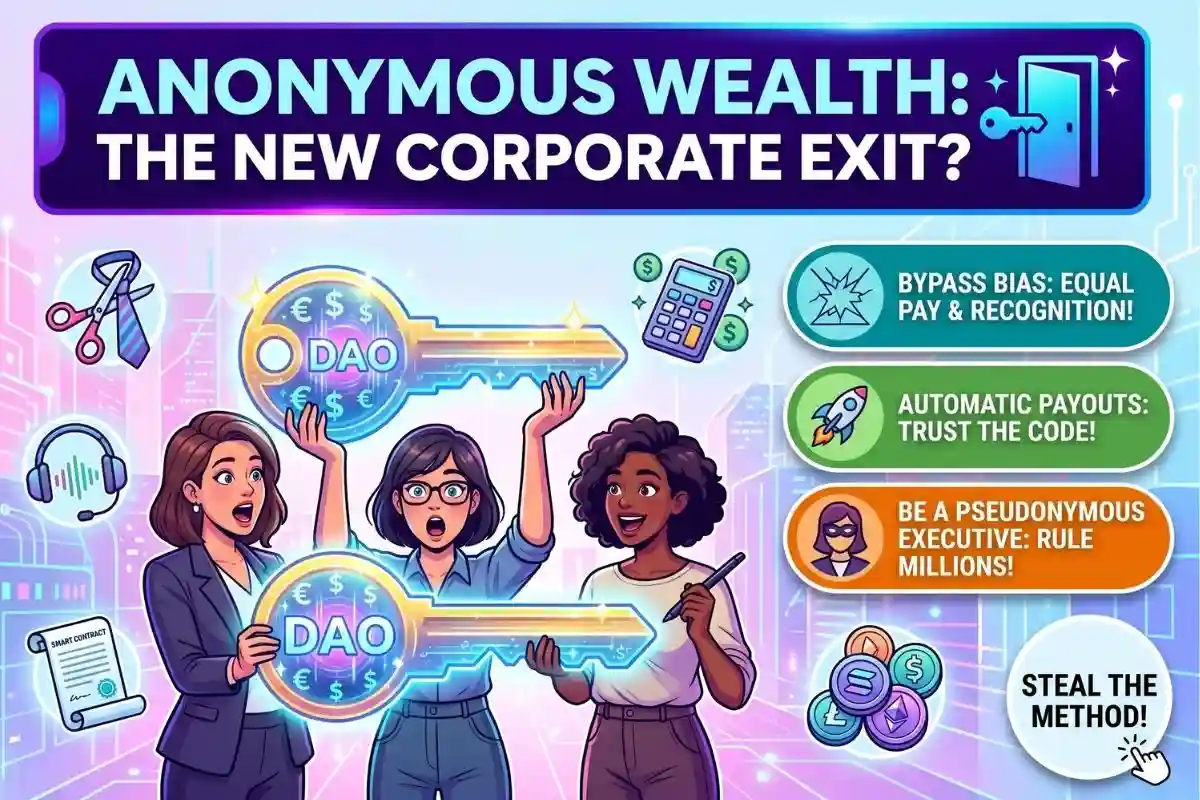
The year is 2026, and the traditional corporate ladder is undergoing a radical, irreversible transformation across the global economy. For decades, professional women have fought tirelessly for seats at boardroom tables, navigating persistent glass ceilings, unspoken biases, and rigid schedules that often clash with the complex realities of modern life. However, a quiet but incredibly powerful revolution is actively reshaping the future of work. Instead of trying to fix a broken, legacy corporate system, thousands of highly skilled women—ranging from seasoned finance executives to brilliant software engineers and creative directors—are simply walking away. They are packing up their virtual desks and migrating toward a radically different professional ecosystem: Web3 and decentralized crypto communities. Specifically, they are finding their authentic voices, generating unprecedented wealth, and realizing their ultimate leadership potential within Female-Led Web3 DAOs. This modern migration is not just a passing internet trend; it is a profound restructuring of how value is created, distributed, and governed in the digital age.
The Great Corporate Exodus
Consider the all-too-familiar story of the modern corporate professional who has spent fifteen years methodically climbing the ranks of a Fortune 500 company, only to realize that the promised rewards of senior leadership are accompanied by unrelenting burnout and restrictive bureaucracy. In the traditional corporate world, women still face deeply ingrained systemic hurdles, including unequal pay, limited access to top-tier executive mentorship, and a pervasive culture that frequently rewards in-office presenteeism over actual productivity and innovation. By 2026, the allure of the prestigious corporate title has completely faded for many, replaced by a deep, undeniable desire for personal autonomy, genuine operational ownership, and truly flexible work environments. Women are realizing that their vast professional expertise—whether in operations, marketing strategy, legal compliance, or community management—is incredibly valuable in the decentralized internet. Instead of waiting years for permission to lead or begging traditional venture capitalists for a fraction of the funding their male counterparts seamlessly receive, they are pivoting to an environment where their contributions are instantly recognized, transparently rewarded, and globally scalable.
Decoding the DAO Advantage for Women
To fully understand the magnitude of this massive professional shift, one must first understand the foundational mechanics of the digital organizations these women are joining and building from the ground up. At its core, a Decentralized Autonomous Organization (DAO) is an entity represented by rules encoded as a transparent computer program, completely controlled by the organization’s members, and not influenced by a central governing body or traditional corporate hierarchy. Unlike a standard company with a CEO, a board of directors, and layers of micromanaging middle management, a DAO operates on a uniquely flat structure where major decisions are made democratically through token-based community voting. For women escaping the rigid, top-down structures of legacy corporations, this decentralized model is profoundly liberating. It essentially replaces the often-biased human element of middle management with impartial, immutable code. If you write a successful proposal, build a necessary digital tool, or organize a highly profitable community initiative, your contribution is permanently visible on the blockchain, and your financial compensation is distributed automatically, completely sidestepping the exhausting office politics that have historically dominated the tech and finance sectors.
Sidestepping Traditional Venture Capital
One of the most significant and empowering catalysts for this corporate migration in 2026 is the total democratization of funding and capital allocation. Historically, female founders have received an abysmal percentage of traditional venture capital funding, often hovering around two to three percent globally, despite consistently building highly profitable and sustainable businesses. Web3 completely flips this outdated and biased script. In a decentralized organization, the community pools its resources into a transparent shared treasury, and members vote collectively on exactly how those funds are deployed. Women are now independently launching massive investment DAOs, global creator collectives, and digital educational hubs, funding them directly through community token distributions rather than relying on the subjective approval of a few wealthy gatekeepers in Silicon Valley. Furthermore, as regulatory frameworks have thankfully matured, government bodies have provided much clearer guidelines on how these digital assets can legally operate. Educational resources from regulatory entities, such as the comprehensive guides available on Investor.gov, have helped demystify the legal landscape, giving professional women the supreme confidence to transition their careers legally and securely into the Web3 space without the lingering fear of operating in an unregulated financial wild west.
Flexibility, Anonymity, and Pure Meritocracy
Beyond the obvious financial empowerment, the unique cultural and lifestyle advantages of Web3 communities are proving absolutely irresistible to the 2026 professional woman. Traditional corporate structures frequently and unfairly penalize women for taking necessary time off for caregiving, or they strictly demand a rigid nine-to-five desk presence that is fundamentally incompatible with managing a modern family life. DAOs, by their very technological nature, are inherently asynchronous, globally distributed, and purely results-oriented. Community members can contribute high-level work to projects at any hour of the day or night, from literally any location in the world, coordinating seamlessly through platforms like Discord and decentralized project management dashboards. Even more revolutionary is the growing concept of pseudonymous professional work. Many prominent and highly paid contributors in the Web3 space operate entirely under digital aliases, represented only by their carefully chosen avatars and their verifiable on-chain track records. This profound level of digital anonymity ensures that innovative ideas and work output are judged strictly on their merit, completely stripping away any conscious or unconscious biases related to gender, race, age, or physical appearance. It has become the ultimate professional meritocracy, beautifully designed for a diverse modern workforce.
The Great Talent Crossover
Consider the specific, highly specialized roles that are seeing the absolute highest rate of transition from traditional corporate environments into Web3 DAOs in recent years. Marketing directors, entirely exhausted by endless corporate approval matrices and stifling brand guidelines, are finding vibrant new life orchestrating grassroots, community-driven campaigns where token holders actively participate in the brand’s creative evolution. Senior legal professionals and compliance officers, once bogged down by mind-numbing legacy bureaucracy, are now at the absolute forefront of the industry, designing innovative governance frameworks and writing smart contract parameters that comply with rapidly evolving global regulations. Even traditional human resources professionals have brilliantly rebranded themselves as “community architects,” focusing heavily on tokenomics-based incentive structures and decentralized conflict resolution rather than simply policing corporate dress codes and managing mundane payroll spreadsheets. This massive, undeniable talent crossover powerfully proves that Web3 is no longer just a playground for hardcore cryptographers and software engineers. It requires a vast, diverse array of professional enterprise skills to function smoothly, and women from all corporate backgrounds are boldly stepping up to fill these crucial leadership voids, bringing much-needed operational excellence and maturity to the decentralized web.
The Data: Traditional vs. Web3 Structures
| Structural Feature | Traditional Corporate Hierarchy (Legacy) | Female-Led Web3 DAO (2026 Model) |
| Leadership Model | Top-down, centralized executives and middle managers. | Flat, decentralized, governed by community consensus. |
| Pay Transparency | Highly secretive, prone to significant gender pay gaps. | 100% transparent, compensation dictated by open code. |
| Work Environment | Location-dependent, strict schedules, presenteeism valued. | Asynchronous, globally distributed, completely output-focused. |
| Funding Access | Requires pitching to heavily male-dominated VC firms. | Crowdsourced directly from community treasuries and token sales. |
| Identity & Bias | Face-to-face evaluations, prone to subconscious biases. | Pseudonymous options available, strict merit-based evaluation. |
Frequently Asked Questions
What exactly is a Web3 DAO, and how does it function day-to-day?
A Web3 DAO is essentially a digital, global cooperative that operates without centralized leadership, using sophisticated blockchain technology to enforce rules and execute community decisions automatically. Instead of a traditional CEO handing down arbitrary directives, community members hold digital governance tokens that grant them proportional voting rights on all major organizational decisions, from how million-dollar treasury funds are spent to exactly what projects the community should pursue next. Day-to-day operations involve members proposing innovative ideas on public forums, rigorously discussing them in open communication channels, and eventually executing a final vote on-chain. Because the foundational rules are written directly into smart contracts, execution is completely trustless and automatic, meaning that once a community vote officially passes, the resulting action—such as transferring project funds to a community lead—happens immediately without requiring any secondary approval from a bank or a corporate finance department.
Is it financially safe to leave a salaried corporate job for a decentralized community?
Leaving a guaranteed, predictable corporate salary always involves some degree of calculated personal risk, but by the year 2026, the global Web3 ecosystem has developed incredibly sophisticated compensation models to protect and sustain its top contributors. While early experimental DAOs paid their members strictly in highly volatile native cryptocurrencies, modern professional DAOs almost universally utilize a much safer hybrid compensation model. Contributors are now frequently paid their base salaries in stablecoins—cryptocurrencies perfectly pegged to the value of the US dollar—to cover all their standard living expenses, while simultaneously receiving native DAO tokens as a powerful equity equivalent for massive long-term financial upside. Furthermore, many professional women do not quit their comfortable corporate jobs overnight; they intelligently begin by contributing to DAOs asynchronously during their evenings and weekends, steadily building up a lucrative secondary income stream and undeniably proving their value within the digital community before officially making the full-time, permanent leap into the decentralized Web3 space.
The Curiosity: The Rise of the Pseudonymous Executive
Here is a truly fascinating curiosity to deeply consider as we actively watch this monumental shift in the modern workforce unfold: the unprecedented rise of the “Pseudonymous Executive.” In traditional corporate structures, the physical identity, the specific educational pedigree, and the visual presentation of an executive are heavily scrutinized and heavily influence their overall career trajectory and promotion potential. In the highly advanced Web3 world of 2026, some of the absolute most successful, profitable, and well-funded female-led DAOs are being brilliantly orchestrated by visionary women who have never once revealed their real names or faces to their loyal communities. They operate safely behind creative digital avatars and verifiable cryptographic signatures, flawlessly managing multi-million dollar global treasuries and orchestrating massive international operations entirely based on their undeniable professional competence and consistent output. This ultimate form of blind digital meritocracy represents a radical, refreshing departure from the restrictive superficialities of legacy corporate culture. It emphatically proves that when the traditional barriers of human bias are entirely removed by impartial blockchain code, professional women do not just casually participate in the future of the internet—they completely and unequivocally dominate it.
