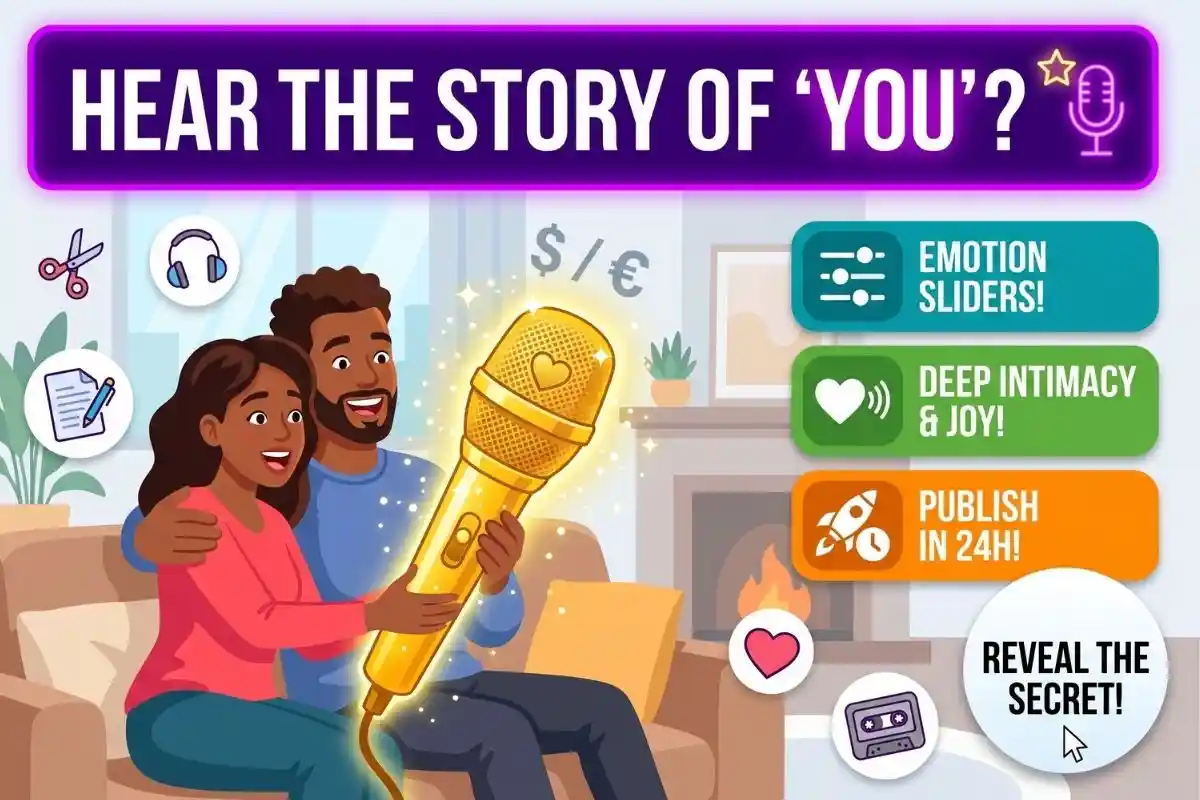
Imagine sitting comfortably on your couch this weekend, sipping a warm cup of coffee, and listening to the beautiful story of how you and your partner first met. But instead of simply reading old text messages or relying on your own fading memory, you hear a rich, beautifully modulated voice narrating the tale like a professional, high-budget audiobook. In 2026, artificial intelligence has evolved far beyond the robotic, monotone GPS navigators of the past. Today, AI romantic voice synthesis allows you to breathe life into your personal love stories, utilizing emotionally custom AI that genuinely understands the nuanced expressions of affection, longing, and joy. Whether you are planning a unique anniversary gift or simply want to immortalize a cherished memory, this weekend is the absolute perfect time to explore how cutting-edge voice generation can transform your written words into an unforgettable auditory experience. This technology is no longer reserved for Hollywood studios; it is highly accessible, incredibly intuitive, and ready for you to use right now from the comfort of your home.
The Remarkable Evolution of Digital Voices
The journey of artificial voices over the past few years has been nothing short of extraordinary. Just a decade ago, computer-generated speech was universally recognizable by its rigid cadence, awkward pauses, and complete lack of emotional depth. If you tried to make an older system read a heartfelt love letter, it sounded more like a robotic customer service prompt than a genuine declaration of affection. However, modern deep learning algorithms have completely revolutionized this digital space. By analyzing thousands of hours of human speech, contemporary AI models have learned to replicate the subtle vocal inflections that convey authentic human emotion. They understand precisely when to pause for dramatic effect, when to soften the volume to express deep tenderness, and how to introduce a slight breathiness that signals vulnerability. This monumental leap relies heavily on advanced neural networks that process text not just as a random string of words, but as a cohesive narrative deeply embedded with emotional context. For a broader understanding of how this incredible technology developed, you can explore the comprehensive history of Speech synthesis on Wikipedia. Today’s advanced systems can instantly analyze the underlying sentiment of your romantic story and automatically adjust their vocal delivery to seamlessly match the mood.
The Mechanics of Emotionally Custom AI
Understanding exactly how these intelligent systems work can significantly help you get the absolute most out of your creative weekend project. When you input your romantic narrative into an advanced AI voice synthesizer, the software immediately performs a complex and rapid sentiment analysis. It carefully looks for punctuation marks, descriptive adjectives, and specific emotional triggers hidden within your text. For instance, a beautifully written sentence describing a bittersweet goodbye will prompt the AI engine to naturally lower its pitch and slow its overall pacing. Conversely, a fond memory of a joyful, energetic reunion will instantly trigger a faster, brighter, and much more enthusiastic tone. Modern users now have access to highly intuitive dashboards where they can manually tweak and perfect these audio parameters. You can effortlessly select a base voice—perhaps a deep, resonant baritone or a warm, soothing alto—and then simply adjust digital sliders for qualities like “warmth,” “intimacy,” and “excitement.” This unprecedented level of granular control means that the voice narrating your personal story will never sound like a generic, unfeeling robot; it will sound like a voice specifically tailored to the unique emotional landscape of your cherished relationship.
Crafting Your Own Love Story This Weekend
So, how do you actually go about creating your very own AI-narrated love story this coming weekend? The entire process is surprisingly straightforward and requires absolutely no prior technical expertise or audio engineering background. First, you need to gather your source material. This could be a lovely collection of early text messages, an old journal entry about your magical first date, or a newly written letter expressing your current feelings. Once your text is polished and ready, choose a reputable AI voice synthesis platform that explicitly offers emotional customization features. Paste your romantic narrative into the platform’s text editor and begin joyfully experimenting with different voice profiles. Take your time to preview short audio snippets, gently adjusting the emotional sliders until the vocal delivery feels exactly right for your specific story. Many popular platforms even allow you to seamlessly layer subtle background music or calming ambient sounds—like soft rain falling against a windowpane or a crackling fireplace—to further enhance the romantic atmosphere. By spending just a couple of peaceful hours on a Saturday afternoon, you can easily produce a high-quality audio file that serves as a beautiful, modern keepsake. It is a highly creative and deeply personal way to fully leverage the remarkable power of Artificial intelligence to celebrate the human connections that matter most.
Why Auditory Memories Resonate So Deeply
There is a highly compelling psychological reason why hearing a personal story spoken out loud is often significantly more impactful than simply reading it silently on a screen or a page. The human brain is evolutionarily hardwired to respond instantly and powerfully to auditory vocal cues. Since the very dawn of human language, oral storytelling has been our primary, most natural method of passing down family history and sharing complex emotions. When we hear a voice that effectively conveys warmth, sincerity, and love, our bodies naturally release oxytocin, the vital hormone directly associated with social bonding and deep affection. By carefully translating your written memories into an emotionally resonant audio format, you are effectively tapping right into this primal, deeply rooted sensory pathway. A beautifully narrated love story can instantly transport you back in time to the exact moment the event happened, effortlessly evoking the very same butterflies and racing heartbeat you happily felt back then. This incredible phenomenon makes AI voice synthesis not just a fun, temporary tech novelty, but a genuinely powerful tool for long-term emotional preservation.
Privacy and Ethical Considerations in Voice Synthesis
As we enthusiastically embrace this remarkable new technology, it is also critically important to briefly touch upon the essential ethical and privacy considerations inherent in modern voice synthesis. When you are securely uploading deeply personal stories and potentially even cloning the digital voices of yourself or your partner, strict data security naturally becomes paramount. It is absolutely crucial to purposefully use established platforms that highly prioritize user privacy and explicitly offer end-to-end encryption for your generated audio files. Always take a few minutes to carefully read the terms of service to firmly ensure that the company does not retain permanent ownership of your customized voice models or your private, intimate texts. Furthermore, the modern ability to create highly realistic synthetic voices naturally brings up important questions of personal consent; you should only ever clone or utilize someone’s distinct voice with their full, explicit permission. By consciously staying informed and purposefully prioritizing secure, ethical platforms, you can safely and happily enjoy the romantic, creative benefits of this technology without ever compromising your personal digital security.
Comparison of Voice Synthesis Technologies
To help you understand the leap in technology, here is a quick breakdown of how today’s tools compare to the systems of the past:
| Feature | Traditional TTS (Pre-2023) | Emotional AI Voices (2026) |
| Emotional Range | Static and heavily monotone | Dynamic, highly context-aware |
| Naturalness | Robotic, choppy, and rigid | Seamless, fluid, human-like |
| Customization | Speed and pitch adjustments only | Intimacy, breath control, cadence |
| User Interface | Often required coding knowledge | Intuitive sliders and drag-and-drop |
| Best Use Case | Basic GPS, automated menus | Audiobooks, personal narratives |
Frequently Asked Questions (FAQ)
Do I need any technical coding skills to create an AI-narrated story?
Absolutely not. The voice synthesis platforms available in 2026 are specifically designed with everyday consumers in mind. They feature highly intuitive, user-friendly graphical interfaces where you simply type or paste your text, select a voice from a visual menu, and adjust simple sliders to control the emotional tone. It is as easy to use as a standard word processor.
Is my private relationship data completely secure with these AI platforms?
Security varies highly by provider, which is why choosing a reputable service is essential. The most trusted platforms in the industry explicitly state in their privacy policies that they immediately delete your text inputs after processing and do not use your private romantic stories to train their public models. Always verify their data retention policies before hitting the generate button.
Can I legally clone my own voice or my partner’s voice for the narration?
Yes, many premium platforms currently offer highly accurate voice cloning features. However, you typically need to record a short script to verify your identity and confirm consent. You should never attempt to clone another person’s voice, including your partner’s, without their explicit knowledge and enthusiastic permission, as this violates both platform terms and basic ethical boundaries.
A Curiosity to Close: The “Phantom Breath”
Did you know that the ultimate secret to making modern artificial intelligence sound perfectly human isn’t actually the generated words themselves, but the silence nestled right between them? Professional audio engineers often refer to this fascinating phenomenon as the “phantom breath.” Early AI speech models meticulously removed all natural breathing sounds, assuming that it made the final audio file sound “cleaner” and more professional. However, human listeners quickly found these breathless voices to be deeply unsettling and entirely unnatural.
Today’s sophisticated romantic voice algorithms are purposefully designed to insert subtle micro-breaths, soft sighs, and realistic vocal hesitations directly into the audio track. These tiny, almost imperceptible imperfections are precisely what trick our human brains into feeling genuine empathy for a digital creation. So, as you sit back this weekend to beautifully narrate your favorite 2026 love stories using customized emotional AI, take a moment to listen closely to those quiet pauses. It is in those artificial breaths that the true magic of modern digital romance is beautifully brought to life, preserving your most cherished memories in a format that will resonate warmly for decades to come.