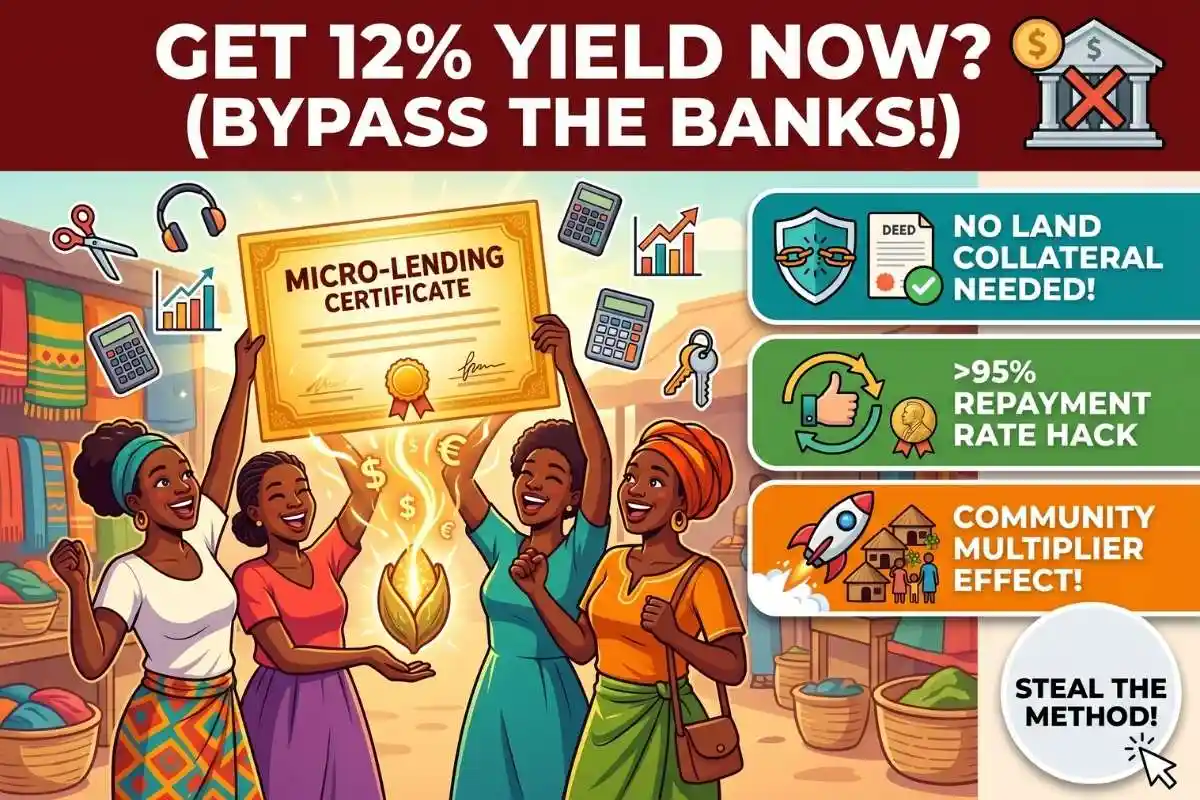
When you place your money into a traditional savings account, it often feels entirely disconnected from the real world. You might earn a modest percentage, but you rarely know what your funds are actively supporting or who they are helping. Imagine, instead, a financial ecosystem where your money not only grows at a highly competitive rate but also fundamentally alters a family’s trajectory. By participating in peer-to-peer (P2P) micro-lending focused on female entrepreneurs, you can bypass institutional middlemen and inject working capital directly into the hands of ambitious women building grassroots businesses. It is a unique intersection where high-yield investing meets profound social impact, offering a completely different way to look at how your portfolio interacts with the global economy.
The Power of Peer-to-Peer Micro-Lending in Emerging Markets
Peer-to-peer lending has revolutionized the way we think about decentralized finance, completely bypassing the massive, sluggish traditional banking system that has dominated the global economy for centuries. Instead of handing your hard-earned capital to a multinational bank—which then lends it out to massive corporations while paying you a fraction of a percent in interest—P2P lending allows you to act as the bank yourself. You are directly connected with individuals who urgently need capital to grow. When we focus this incredible financial tool on emerging markets, particularly across the African continent, the results are nothing short of extraordinary. In many parts of Africa, ambitious, hardworking individuals run thriving small-scale enterprises but are systematically locked out of formal financial institutions because they lack traditional collateral like real estate or massive corporate guarantors. By utilizing modern digital lending platforms, everyday investors from around the globe can step into this gap, providing vital working capital directly to these energetic entrepreneurs. This decentralized approach democratizes access to wealth creation, allowing you to deploy your money in a way that generates real, tangible economic activity at the grassroots level rather than getting lost in the abstract derivatives market of Wall Street.
Why Women-Led Startups Are Driving Exceptional Returns
Why should investors specifically target women-led startups in these regions? The answer lies in a powerful combination of statistical reliability and profound socio-economic impact. Decades of economic development research have consistently demonstrated that female entrepreneurs are historically far more reliable borrowers than their male counterparts. Women in developing economies tend to view their business ventures not merely as profit-making engines, but as vital lifelines for their families and communities. According to broader economic development reports from organizations like the United States Agency for International Development (USAID), women reinvest a significantly higher percentage of their earnings back into their households—funding education, better nutrition, and community health initiatives. When you fund a female entrepreneur, you are essentially triggering a powerful multiplier effect that lifts up entire neighborhoods. Her success naturally bleeds into the local economy as she hires local helpers, purchases raw materials from nearby farmers, and provides essential services to her neighbors. This extraordinary level of dedication translates directly into incredibly high loan repayment rates, which ultimately secures the investor’s capital. By focusing on women, investors aren’t just making a feel-good charitable donation; they are making a highly rational, data-backed financial decision that minimizes default risk while maximizing social dividends.
The Mechanics of Earning a 12% Yield
You might be wondering how a 12% yield is mathematically possible in a world where standard government bonds and savings accounts offer single-digit returns. The secret lies in the massive inefficiencies of the legacy financial system and the high profitability of micro-enterprises. In many developing nations, local loan sharks or legacy microfinance institutions charge astronomical interest rates—sometimes upwards of 40% to 50% annually—because they hold a monopoly on capital. P2P lending platforms disrupt this exploitative model by connecting borrowers directly to international investors. Even if a borrower pays a 15% to 18% interest rate on a platform, it is a massive, life-changing discount compared to their local alternatives. The platform takes a small percentage to cover operational costs, currency hedging, and field partner management, leaving a highly attractive 12% yield for the individual investor. It is essential to understand that this yield is a reflection of the borrower’s incredible return on capital. A market trader who borrows $500 to buy bulk inventory might turn that into $1,000 in revenue within just a few months. Paying back $560 (the principal plus a 12% annualized return) is completely manageable for her, making it a highly sustainable financial ecosystem.
Real-World Impact: Transforming Communities in Ghana
To truly grasp the power of this investment vehicle, let us look at a practical, real-world example based right here in Ghana. Picture a vibrant, bustling market in Accra, where an experienced female trader specializes in selling beautifully patterned textiles and locally manufactured garments. Despite having a loyal customer base and proven sales skills, she is severely limited by her inability to buy inventory in bulk. A local commercial bank will not give her a business loan because she doesn’t own the land her market stall sits on. Through a P2P micro-lending platform, an investor funds her specific project with a $1,000 loan. With this injection of capital, she bypasses middle-men and purchases directly from the regional textile factories at a wholesale discount. Within weeks, her profit margins double. She expands her stall, hires an assistant from her community, and easily meets her monthly repayment schedule. The investor sitting thousands of miles away checks their dashboard and watches their principal return with that steady 12% yield. This is not an isolated fairy tale; it is a daily reality across the African continent, proving that targeted micro-capital can instantly dismantle structural poverty while rewarding the people who provide the funding.
How to Start Investing and Mitigating Your Risks
While the promise of high yields and profound social impact is undeniably attractive, smart investing always requires a clear understanding of the risks involved and how to properly mitigate them. P2P micro-lending is an alternative asset class, which means it should not replace your emergency fund or your core retirement accounts. The most critical strategy for success in this space is aggressive diversification. Rather than lending $1,000 to a single entrepreneur, a wise investor will spread that capital across 100 different women in various sectors—from agriculture and retail to manufacturing and services—using automated tools provided by the lending platforms. If one borrower faces an unexpected hardship, such as a localized crop failure or a sudden illness, the default will only represent a tiny fraction of your overall portfolio, leaving your aggregated returns largely intact. Furthermore, it is vital to only utilize reputable platforms that transparently report their historical default rates and employ solid currency risk management strategies. As always, educating yourself through authoritative resources, such as the basic investment principles outlined on the U.S. Securities and Exchange Commission’s Investor.gov, will help you build a resilient, balanced portfolio that aligns with both your financial goals and your personal values.
Comparing Investment Avenues
To help you visualize where P2P female micro-lending sits within your broader financial strategy, here is a quick comparison of standard investment vehicles.
| Investment Type | Expected Annual Yield | Social Impact Level | Primary Risk Factor |
| Traditional Savings | 1% – 4% | Very Low | Inflation outpacing growth |
| Broad Market Index Funds | 7% – 10% | Low to Moderate | Market volatility |
| P2P Female Micro-Lending | 10% – 12% | Exceptionally High | Borrower default / Currency flux |
| Government Bonds | 3% – 5% | Low | Interest rate shifts |
Frequently Asked Questions (FAQ)
Is peer-to-peer micro-lending safe for everyday investors?
No investment is entirely without risk, and P2P lending is not FDIC-insured like a traditional bank account. The primary risk is borrower default. However, by strictly diversifying your funds across hundreds of different loans and utilizing reputable platforms that vet their borrowers through trusted local field partners, you can mathematically minimize this risk. Historically, female entrepreneurs in these programs maintain repayment rates exceeding 95%.
Can I withdraw my money at any time?
Unlike a highly liquid stock or a standard savings account, micro-loans are tied to real-world business cycles. Your money is actively being used to buy inventory or equipment. Therefore, your capital is returned to you gradually over the term of the loan (usually 6 to 24 months) as the borrower makes her monthly repayments. You can withdraw the cash as it flows back into your account, or choose to reinvest it.
Why do these entrepreneurs need international investors instead of local banks?
In many developing economies, traditional commercial banks are highly risk-averse and not structured to handle micro-businesses. They require extensive documentation, formal credit histories, and hard physical collateral—things most market traders simply do not have. P2P platforms bridge this gap by relying on alternative credit scoring, community trust models, and the collective funding power of everyday global citizens.
The Curiosity Corner: A Nobel-Winning Idea
Did you know that the entire concept of structured micro-lending is relatively modern and actually won a Nobel Peace Prize? In the 1970s, an economics professor named Muhammad Yunus visited an impoverished village and discovered that local women were entirely trapped in poverty because they relied on predatory lenders to buy simple materials like bamboo for weaving stools. Yunus lent $27 of his own money to 42 different women, completely interest-free, allowing them to break the cycle of debt. Every single cent was repaid.
This simple experiment birthed the Grameen Bank, proving to the world that the poor are incredibly creditworthy. Today, digital P2P platforms have simply taken Yunus’s brilliant realization and supercharged it with the internet, allowing anyone with a smartphone to become a catalyst for global change while building their own financial future.