Every fiction writer knows the creeping dread that sets in around the midpoint of a novel or the third book of a series. You are typing furiously, riding the wave of creative flow, when suddenly you realize that the protagonist’s magical amulet—the one they dramatically destroyed in chapter four—is somehow back around their neck in chapter twenty. Traditional outlining often fails to catch these intricate continuity errors, leaving authors to spend hours frantically rereading their own manuscripts instead of writing new words. The dream of completing a massive word-count sprint over a single weekend is frequently derailed by the sudden need to untangle a web of contradictory timelines, forgotten character motivations, and glaring plot holes that threaten to collapse the entire fictional universe.
The Evolution of the Series Bible
Historically, authors have relied on physical binders, index cards, or massive spreadsheet documents to keep track of their sprawling narratives. A series bible is an essential reference document that catalogs everything from character backstories and family trees to the specific rules of magic systems and planetary geographies. You can read more about the conceptual history of a story bible on Wikipedia. While these static documents are incredibly useful, they require meticulous manual updating and rely entirely on the author’s flawed human memory to cross-reference facts while drafting. When you are deeply immersed in the emotional climax of a scene, stopping to check a spreadsheet to see if a side character’s eyes are blue or green is enough to completely shatter your creative momentum.
AI as Your Digital Continuity Editor
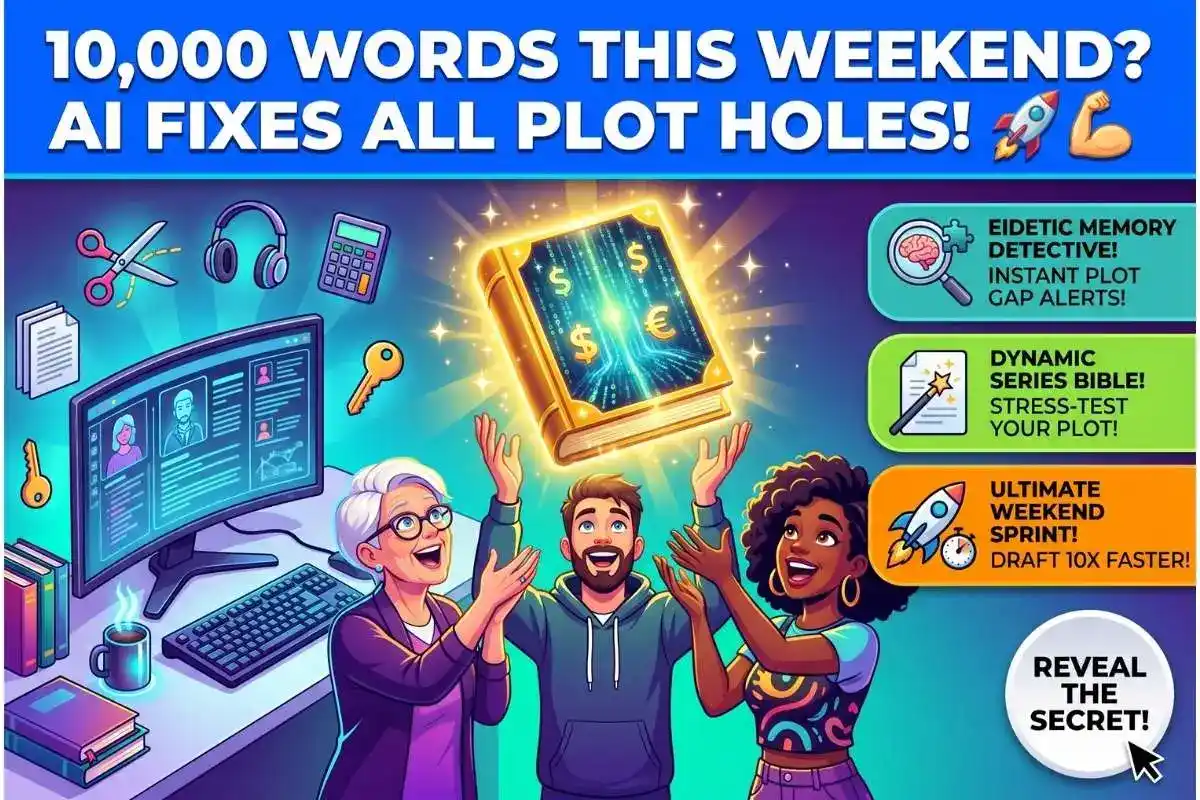
This is where artificial intelligence transforms the grueling pre-writing process into a streamlined, highly efficient system. By feeding your character profiles, world-building rules, and chapter-by-chapter summaries into a secure, context-aware AI model, you effectively hire a digital continuity editor with an eidetic memory. Instead of merely storing your information like a traditional database, the AI actively analyzes the relationships between different narrative elements. It can instantly flag inconsistencies, such as a character being in two places at once, or a critical plot device being introduced without any prior foreshadowing. This dynamic interaction allows you to test different narrative pathways and instantly see how a single change ripples throughout the entire series architecture, ensuring your story logic remains perfectly intact from the prologue to the epilogue.
Fixing Plot Holes Before They Hatch
Plot holes are the absolute bane of reader immersion, often turning a five-star review into a frustrated rant about narrative logic. When an author relies purely on “pantsing”—writing spontaneously by the seat of their pants without a structured plan—these narrative gaps are almost inevitable, requiring brutal structural revisions during the editing phase. Automated outlining tools allow you to stress-test your plot before you have invested thousands of words into a doomed storyline. You can prompt the AI to look for weaknesses in your antagonist’s master plan or ask it to verify that the timeline of events makes logistical sense based on the travel distances in your fictional world. Catching these structural flaws during the outlining phase saves an immeasurable amount of time and emotional energy.
Structuring the Ultimate Weekend Sprint
The true magic of an AI-optimized series bible reveals itself when you sit down for a dedicated, high-volume writing sprint over a long weekend. With all the heavy lifting of world-building and continuity already resolved, your cognitive load is entirely freed up to focus on prose, pacing, and character voice. You no longer have to pause your creative flow to figure out the logistics of a heist or the specific mechanics of a futuristic weapon system. Your AI assistant has already mapped out the exact sequence of events, verified the structural integrity of the plot, and provided you with a bulletproof roadmap. This level of extreme preparation is what allows prolific authors to comfortably draft ten thousand words or more in a single weekend without burning out.
Data Privacy and the Future of Authorship
Naturally, the integration of artificial intelligence into the deeply personal realm of creative writing raises valid concerns regarding copyright and data security. It is absolutely crucial for authors to utilize AI platforms that explicitly guarantee the privacy of their intellectual property and do not use user data to train public models. The United States Copyright Office continues to evaluate the complex intersection of AI-generated content and human authorship, emphasizing that human creativity must remain the core driver of the work. When used ethically and securely, an AI series bible acts not as a replacement for human imagination, but as a powerful scaffolding tool that supports the author’s original vision, allowing them to produce their best work faster and with significantly less frustration.
Outlining Systems Compared
| Feature | Traditional Series Bible | AI-Assisted Series Bible |
| Data Retrieval | Manual searching through folders and spreadsheets | Instant conversational recall via text prompts |
| Continuity Checking | Relies entirely on the author’s memory | Automated flagging of logical inconsistencies |
| Idea Generation | Brainstorming alone or with a co-writer | Collaborative structural feedback in real-time |
| Updating Process | Tedious manual entry across multiple documents | Dynamic updates that auto-sync across the narrative |
Frequently Asked Questions
Can an AI series bible accidentally steal my original story ideas? The fear of intellectual property theft is a common and highly valid concern among creators venturing into the world of artificial intelligence tools for the first time. To protect your work, it is imperative to exclusively use paid or enterprise-level AI services that feature strict, transparent data privacy agreements explicitly stating they do not train their foundational models on your private inputs. By carefully reading the terms of service and opting out of data-sharing programs, authors can safely utilize these powerful tools as private, enclosed digital workspaces. Your story remains entirely your own; the software simply acts as a secure organizational vault that processes your original text without broadcasting it to the wider internet or recycling it for other users’ generations.
Does relying on automation destroy the spontaneous joy of creative writing? Many discovery writers—often referred to affectionately as “pantsers” in the publishing community—worry that meticulously outlining a novel with AI will make the actual drafting process feel like a monotonous chore. However, using automation to verify your narrative logic actually provides you with a much safer sandbox in which to play, experiment, and let your imagination run completely wild. Because you already know the structural foundation is solid and the plot holes are patched, you can afford to take massive creative risks with your prose, your dialogue, and your character interactions during the drafting phase. Rather than destroying spontaneity, the safety net of an automated series bible frequently enhances it, allowing you to focus entirely on the art of storytelling without the constant fear of breaking the plot.
What is the learning curve for setting up an automated story bible? While the underlying technology of large language models is incredibly complex, the user interfaces for modern writing-focused AI platforms have been specifically designed to be as intuitive and user-friendly as possible. Authors do not need to possess any specialized coding knowledge or advanced prompt engineering skills to build a highly effective automated continuity system. The process generally begins by simply uploading your existing notes, character sheets, and chapter summaries in plain English text. From there, you interact with the software conversationally, asking it direct, natural questions about your fictional universe just as you would speak to a trusted human editor or a co-author. Within a matter of hours, most writers feel completely comfortable navigating the system and extracting incredibly valuable insights for their upcoming manuscripts.
Curiosity: The Origins of the Story Bible
Before we conclude, consider this fascinating parallel between modern artificial intelligence and historical literary practices. The concept of maintaining a massive, collaborative story bible was heavily popularized by the television industry, most notably during the production of the original Star Trek series in the 1960s, where writers desperately needed a centralized document to keep the rules of the universe consistent across dozens of different episodes. Today, we are simply taking that same collaborative spirit and digitizing it, replacing the overcrowded writers’ room with an infinitely patient, always-available digital assistant. As you prepare for your next massive weekend writing sprint, remember that you are participating in a rich tradition of narrative world-building, supercharged by the most powerful technological advancements of our modern era.