
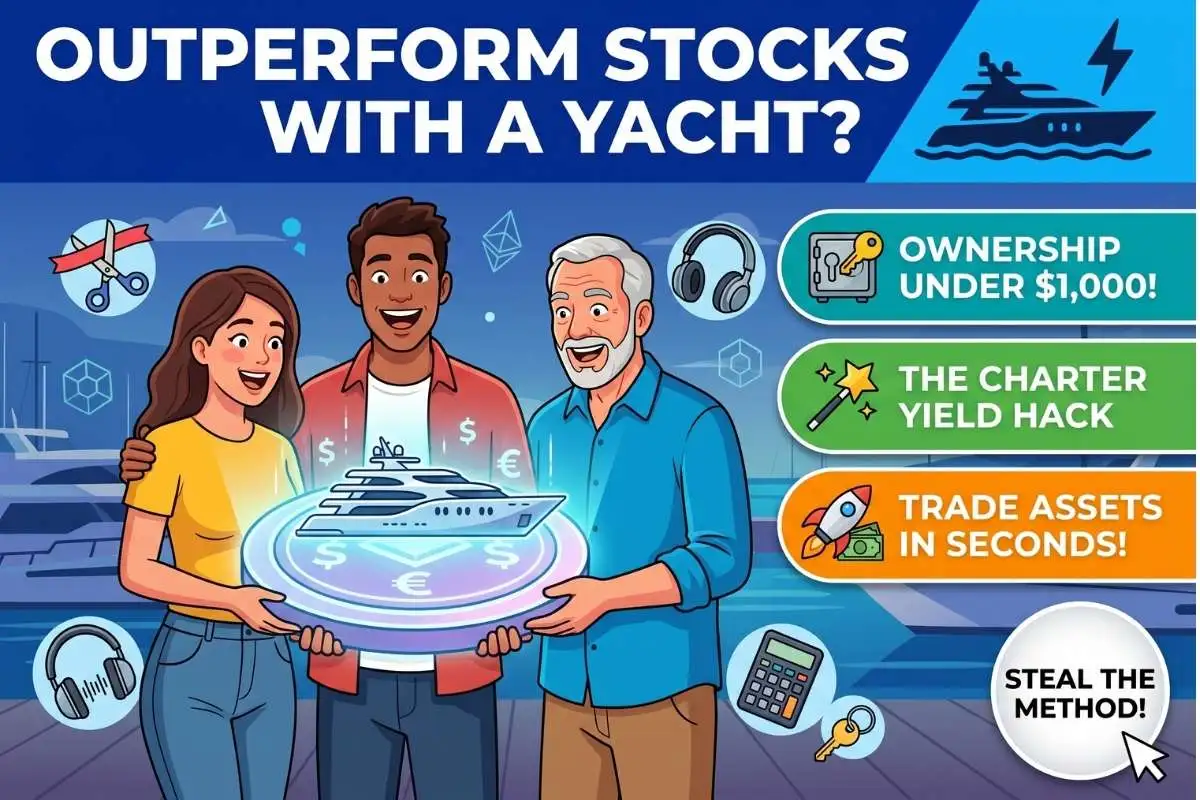
Picture a sleek, fifty-million-dollar superyacht docked in the glittering marina of Monaco. The sun bounces off its pristine decks, and the crew stands ready, polishing the chrome until it gleams like a mirror. It is the ultimate symbol of wealth, freedom, and luxury. But beneath this glamorous surface lies a harsh financial reality: that magnificent vessel likely sits completely idle for over three hundred days a year. All the while, it quietly burns through millions of dollars in docking fees, insurance premiums, and maintenance costs without generating a single cent of income. For decades, this was just the accepted price of entering the billionaire’s club. However, the financial tides are shifting dramatically this May. A revolutionary concept known as Real World Asset (RWA) tokenization is rewriting the rules of luxury ownership, transforming these massive, illiquid liabilities into dynamic, yield-generating investments that are suddenly catching the eye of Wall Street and outperforming traditional stock portfolios.
The Crushing Economics of Traditional Luxury
For generations, the financial mechanics of owning a superyacht have been notoriously brutal, widely considered by financial advisors to be a textbook example of capital destruction. When a high-net-worth individual purchases a vessel for fifty million dollars, the initial price tag is merely the beginning of an endless financial drain. Industry standards dictate that annual operating costs—encompassing full-time crew salaries, premium marina berthing, specialized maritime insurance, winterization, and regular mechanical overhauls—typically run between ten and fifteen percent of the yacht’s total value. This means our hypothetical owner is bleeding roughly five to seven and a half million dollars every single year, regardless of whether the boat leaves the dock. Furthermore, the asset itself is rapidly depreciating, and the secondary market is incredibly sluggish; selling a large vessel can easily take twelve to eighteen agonizing months of negotiations and broker fees. Ultimately, traditional yacht ownership has never been about making a smart investment; it has always been an emotional purchase, a floating status symbol that quietly drains generational wealth while providing only a few weeks of actual enjoyment per year.
The Blockchain Solution: Tokenizing the High Seas
Enter the transformative power of Real World Asset (RWA) tokenization, a financial innovation that is fundamentally disrupting how we interact with physical wealth. Instead of relying on a single billionaire to shoulder the immense financial burden of a massive vessel, tokenization leverages blockchain technology to divide the ownership of the yacht into thousands, or even millions, of digital shares known as tokens. The process begins by placing the physical yacht into a legally compliant corporate structure, typically a Special Purpose Vehicle (SPV). The shares of this SPV are then digitally minted as security tokens on a blockchain, ensuring transparent, immutable, and easily transferable ownership records. By doing this, a fifty-million-dollar asset can be fractionalized, allowing an investor to purchase a stake for as little as a few thousand dollars. These digital assets are strictly regulated, often falling under the purview of financial watchdogs. You can read more about the legal classification of these digital assets on resources like Wikipedia’s guide to Security Tokens and track regulatory compliance standards through official government portals like the U.S. Securities and Exchange Commission (SEC). This digital leap turns an impenetrable fortress of wealth into an accessible, liquid marketplace.
Why May 2026 is the Turning Point for Marine RWAs
As we navigate through May 2026, the global financial landscape is experiencing a profound shift that makes tokenized yachts incredibly attractive compared to traditional equities. The stock market has been battling stubborn volatility, unpredictable interest rate environments, and tech-sector fatigue, leaving investors desperate for alternative assets that offer tangible value and uncorrelated returns. The RWA sector has exploded in response, surging past twenty-nine billion dollars in total on-chain value as institutional money pours into tokenized real estate, gold, and private credit. Superyachts have emerged as the surprise darling of this movement because they offer a highly lucrative and measurable cash flow: the luxury charter market. When a tokenized yacht is not being used by its fractional owners, it is leased out to vacationers at exorbitant rates—often upwards of five hundred thousand dollars per week for a premium vessel. Because smart contracts on the blockchain automate the distribution of this income, token holders receive direct, proportional dividend payouts from the charter revenue, completely bypassing traditional corporate bureaucracy and creating a robust yield that is currently outpacing the sluggish dividend returns of the S&P 500.
Democratizing the Ultimate Status Symbol
The true genius of this tokenized model lies in its ability to democratize access while simultaneously optimizing the asset’s utility and financial performance. In the past, a yacht owner had two bad choices: leave the boat idle and absorb massive losses, or deal with the logistical nightmare of managing a charter business alone. Today, tokenization aligns the incentives of everyone involved by crowdsourcing the capital and sharing the rewards. An investor buying into a tokenized superyacht isn’t just buying a piece of a boat; they are acquiring a stake in a floating, revenue-generating business with built-in global demand from the booming luxury tourism sector. When the yacht generates charter income, the smart contract automatically deducts the necessary operational costs—crew, fuel, and maintenance—and instantly distributes the net profits to the digital wallets of the token holders. Furthermore, many tokenization platforms offer utility benefits, granting investors fractional usage rights based on their holding size. This means an investor could earn an eight percent annual yield from charter revenues while also enjoying a discounted week cruising the Mediterranean, fundamentally changing the definition of luxury ownership from exclusive hoarding to collaborative, profitable sharing.
Comparing the Waters: Traditional vs. Tokenized
To truly grasp why this asset class is making waves, we must look at the stark contrast between the old way of doing things and the new, blockchain-empowered methodology.
| Feature | Traditional Yacht Ownership | Tokenized RWA Ownership |
| Initial Capital Required | $10 Million – $500 Million+ | Can be as low as $1,000 |
| Annual Maintenance Costs | 10% – 15% of asset value (Owner pays all) | Shared proportionally, covered by charter revenue |
| Liquidity | Extremely low (12-18 months to sell) | High (Tokens traded 24/7 on digital exchanges) |
| Revenue Generation | Rare, usually operated at a massive net loss | Automated dividend payouts via smart contracts |
| Target Demographic | Ultra-High-Net-Worth Individuals | Retail investors, funds, and crypto enthusiasts |
Frequently Asked Questions (FAQ)
What exactly is an RWA in the context of cryptocurrency? RWA stands for Real World Asset. It refers to the process of linking a physical, tangible asset—like real estate, fine art, commodities, or in this case, superyachts—to a digital token on a blockchain. This bridges traditional finance with decentralized finance (DeFi), bringing transparency, liquidity, and fractional ownership to historically rigid markets.
How is the yacht legally tied to the digital tokens? The physical yacht itself isn’t what floats on the blockchain. Instead, the vessel is purchased and held by a specialized corporate entity called a Special Purpose Vehicle (SPV). The tokens minted on the blockchain represent legal equity shares in that specific SPV. Therefore, owning the token legally means owning a proportional share of the company that legally owns the boat.
What happens if the yacht sinks or gets damaged? Just like any multi-million dollar asset, tokenized yachts are heavily insured with comprehensive maritime policies. If a catastrophic event occurs, the insurance payout goes to the SPV, which then distributes the recovered funds proportionally to the token holders. Routine maintenance and minor damages are covered by the yacht’s operational budget, which is funded by the charter income before dividends are paid out.
Is this regulated, or is it the “Wild West” of crypto? Because these tokens represent equity in a company that generates an expectation of profit, they are overwhelmingly classified as securities. As a result, reputable tokenization platforms must comply with strict financial regulations, requiring investors to pass Know Your Customer (KYC) and Anti-Money Laundering (AML) checks, and often requiring them to be accredited investors depending on their jurisdiction.
The Final Wave: Beyond the Horizon
We are standing on the shores of a massive financial paradigm shift. The tokenization of superyachts is not merely a novelty or a gimmick for the ultra-rich; it is a profound proof of concept for the future of all physical assets. If you can take one of the most notoriously illiquid, depreciating, and expensive items on the planet and successfully transform it into a liquid, high-performing, yield-generating digital asset, then the implications for the rest of the global economy are staggering. This May, as traditional markets continue to chop sideways, the investors looking out at the horizon are realizing that the best returns might not be found on the floor of a stock exchange, but rather anchored in a marina, tokenized, and working efficiently for thousands of owners simultaneously. The era of idle luxury is sinking, making way for the streamlined, democratic, and highly profitable future of tokenized wealth.
