
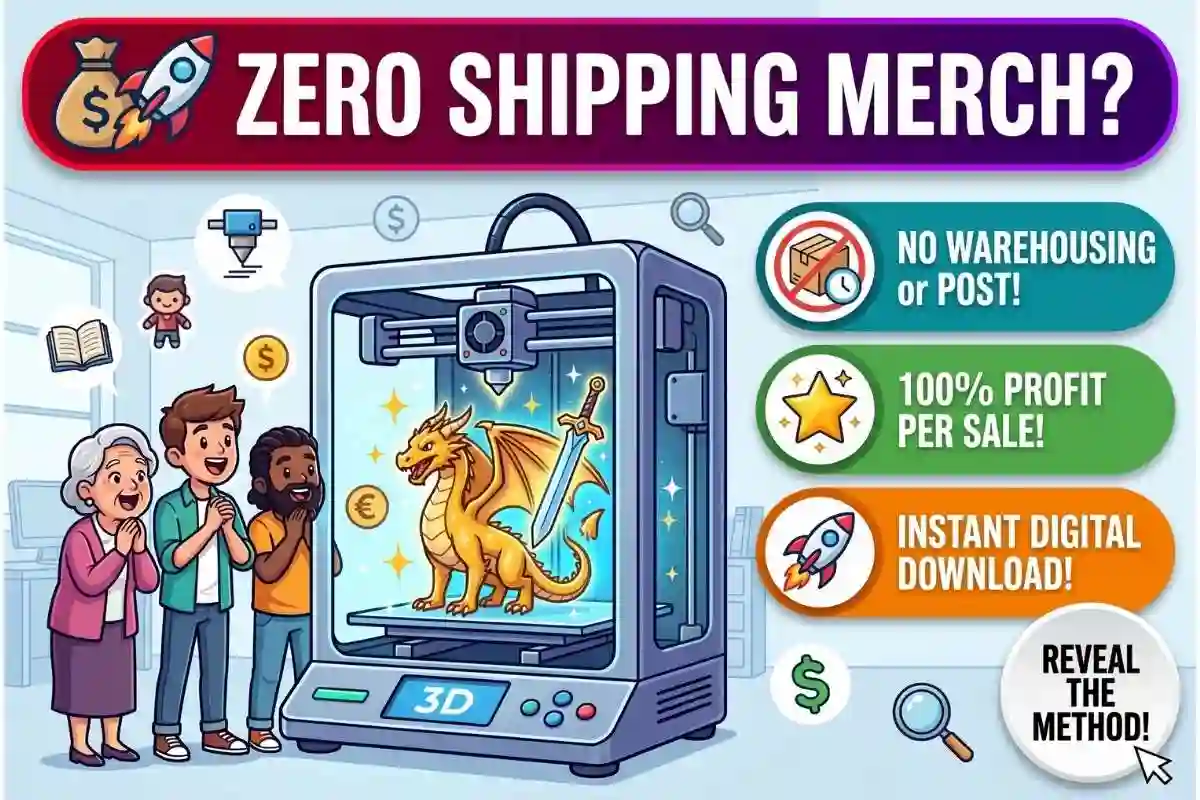
For decades, the sacred bond between an author and a reader was mostly confined to the fragile pages of a book or the glowing screen of an e-reader. If you thoroughly enjoyed a story, you patiently waited for the sequel to be released, or perhaps you purchased a branded bookmark or a mass-produced poster. But today, the creator economy has radically transformed how storytellers interact with their most dedicated followers. Enter the fascinating era of “digital swag.” Independent authors, particularly those writing in the fantasy, science fiction, and tabletop gaming genres, have discovered an innovative and highly lucrative way to monetize their intellectual property without ever having to visit a crowded post office. By offering 3D printable digital files of their characters, mythical artifacts, and intricate world maps, they are providing superfans with a deeply immersive, hands-on experience. This digital merchandise strategy allows readers to physically manufacture keepsakes right in their own homes, beautifully bridging the gap between a writer’s imagination and tangible reality.
The New Frontier of Fandom Merchandise
Imagine finishing a gripping, six-hundred-page fantasy novel where the protagonist wields a uniquely intricate, deeply magical broadsword. In the past, holding a physical replica of that specific sword was a rare luxury, an experience reserved almost entirely for fans of massive, billion-dollar franchises like The Lord of the Rings or Star Wars, which had the financial backing of global toy manufacturers. Today, however, independent authors are democratizing this experience by commissioning talented digital sculptors to create highly detailed, three-dimensional models of their proprietary items, beloved characters, and even prominent architectural landmarks from their fictional worlds. These digital files, typically delivered in universal formats like STL or OBJ, are then sold directly or given as premium rewards to the author’s most passionate readers. The superfans can then take these digital blueprints, feed them into their own personal 3D printers, and physically manifest a piece of the story they love. This creates an incredibly powerful, tactile connection to the narrative. Instead of passively consuming a story, the reader becomes an active participant in the merchandising process, carefully printing, assembling, and often hand-painting these customized miniatures to display proudly on their bookshelves alongside the novels that originally inspired them.
The Economics of Bits Over Atoms
The traditional physical merchandising model has always been an absolute logistical nightmare for independent creators, fraught with prohibitively high upfront costs, complex supply chain management, and the perpetual, terrifying risk of unsold inventory gathering dust in a garage. If an author wanted to sell a custom plastic figurine of their main character, they had to pay thousands of dollars for steel injection molds, order a minimum of a thousand units from an overseas factory, arrange for complicated international shipping, and then manually pack and mail every single order themselves. By pivoting entirely to 3D printable files, modern authors completely eliminate these massive overhead costs and stressful logistical hurdles. Because they are selling digital bits instead of physical atoms, the profit margins are exceptionally high, often approaching one hundred percent after the initial cost of the freelance digital sculpt has been fully recouped. A single file can be sold infinitely, to one single fan or ten thousand fans worldwide, with absolutely no additional manufacturing, warehousing, or shipping costs on the author’s end. For more context on the incredible underlying technology driving this economic shift, you can explore the extensive history and capabilities of 3D printing on Wikipedia, which outlines exactly how additive manufacturing has disrupted traditional production models across multiple global industries.
The Technological Shift Fueling the Trend
This incredibly lucrative new revenue stream for authors would be entirely impossible without the rapid, widespread consumer adoption of additive manufacturing technology over the last few years. Just a decade ago, desktop 3D printers were incredibly expensive, notoriously difficult to calibrate, and mostly confined to the dusty basements and workshops of hardcore engineering hobbyists. Today, the consumer landscape is radically different. High-resolution resin printers, which are uniquely capable of capturing the microscopic, intricate details required for tabletop gaming miniatures and delicate character statues, can now be purchased for less than the cost of a modern video game console. Furthermore, the specialized software used to slice these digital models and prepare them for printing has become incredibly user-friendly, often operating with simple, intuitive plug-and-play interfaces. This widespread accessibility means that a significant, ever-growing portion of an author’s readership either owns a 3D printer themselves or has a close friend or family member who does. In many modern communities, local public libraries and collaborative maker spaces also provide free or exceptionally low-cost access to these impressive machines, ensuring that even fans who cannot afford their own dedicated hardware can still actively participate in this unique form of digital merchandise collection.
Platforms and Communities Supporting the Shift
Authors are cleverly leveraging a wide variety of established digital platforms to distribute these 3D printable files, seamlessly integrating them into their existing book marketing and monetization strategies. Crowdfunding websites like Kickstarter have become major centralized hubs for this specific activity; authors frequently bundle exclusive 3D character models as enticing “stretch goals” to incentivize higher financial pledge tiers during a highly anticipated new book launch. Subscription platforms like Patreon are equally popular, allowing authors to confidently offer a recurring “Miniature of the Month” club where loyal, paying subscribers receive a brand-new digital file every thirty days in exchange for their ongoing financial support. Beyond the immediate and obvious financial benefits, this strategy fosters an incredibly vibrant, highly engaged fan community. Fans frequently gather in dedicated Discord servers or private Facebook groups to excitedly share high-quality photographs of their freshly printed and meticulously hand-painted models, exchanging helpful tips on precise print settings and advanced painting techniques. This incredible wealth of user-generated content acts as powerful, organic marketing for the author’s books, drawing entirely new readers into the fold who are attracted by the stunning physical artifacts being widely shared across social media.
Protecting Intellectual Property in a Digital Age
While the financial and community-building benefits of selling digital swag are truly immense, this modern merchandising model does introduce a set of brand-new challenges, particularly regarding the ongoing protection of an author’s valuable intellectual property. Digital files, by their very inherent nature, are incredibly easy to maliciously copy, share, and distribute illegally across the internet. Authors must be highly proactive in clearly communicating the specific licensing terms associated with their 3D models, usually specifying explicitly that the files are intended for personal, strictly non-commercial use only. This means a dedicated fan can print as many copies as they reasonably want for their own personal display, but they absolutely cannot legally sell the physical prints at a convention or distribute the raw digital file to others online. To combat digital piracy, some creators utilize embedded digital watermarking techniques, while others rely heavily on the goodwill and self-policing nature of their dedicated fan communities to swiftly report unauthorized sharing. For creators looking to thoroughly understand their legal rights in the digital landscape, the United States Copyright Office provides comprehensive, authoritative resources on exactly how copyright law applies to digital creations, architectural works, and three-dimensional sculptures, ensuring that authors can confidently protect their hard-earned creative assets.
The Merchandising Showdown: Physical vs. Digital
To better understand why so many authors are making this transition, it helps to look at the hard data comparing traditional merchandising methods with the new wave of 3D printable digital swag.
| Feature / Metric | Traditional Physical Merch (e.g., molded toys) | 3D Printable Digital Merch (STL/OBJ files) |
| Upfront Production Cost | Extremely High ($2,000+ for molds & minimums) | Low to Medium ($100 – $500 for a 3D sculpt) |
| Inventory Risk | High (Unsold items waste money and space) | Zero (Files are stored digitally) |
| Shipping & Fulfillment | Expensive, time-consuming, prone to global delays | Instantaneous digital download, zero shipping cost |
| Profit Margin | Typically 20% – 40% per item | Nearly 100% after the initial sculpt is paid off |
| Fan Customization | None (Fans receive an identical, pre-painted item) | High (Fans choose the print scale and paint it themselves) |
Frequently Asked Questions (FAQ)
Do I need to know how to digitally sculpt or 3D model to offer this to my fans? Not at all! The vast majority of authors offering digital swag have absolutely no background in 3D modeling. They act as art directors, hiring talented freelance digital sculptors from platforms like ArtStation or Fiverr to bring their specific character descriptions to life. The author pays a one-time fee for the commercial rights to the digital design, and then handles the distribution to their readers.
What happens if the majority of my readers don’t actually own a 3D printer? This is a very common concern, but it shouldn’t hold you back. First, many readers use third-party, print-on-demand services where they simply upload your file, and a company prints and mails the physical object to them. Additionally, some authors offer special “Merchant Tier” licenses on their Patreons. This allows small, independent 3D printing businesses to legally print and sell physical copies of your merchandise to fans who lack the hardware, creating a win-win ecosystem.
Are there specific book genres that perform better with 3D printable merchandise? Yes. While any genre can theoretically utilize this, it is massively popular in Fantasy, Science Fiction, LitRPG, and GameLit. These genres naturally feature highly distinct props, imaginative armor, alien spaceships, and monstrous creatures that fans are already eager to visualize. Furthermore, there is a massive overlap between readers of these specific genres and the tabletop role-playing game (RPG) community, who are already avid collectors and painters of 3D miniatures.
Curiosity Corner: A Summary of Imagination
It is absolutely fascinating to consider how far the concept of “merchandise” has evolved in such a short amount of time. 3D printing technology is currently being utilized by NASA aboard the International Space Station to manufacture vital tools in zero gravity, yet that exact same underlying technology is sitting on the desks of everyday book lovers, allowing them to summon miniature dragons and magical artifacts out of thin air. Ultimately, the rise of digital swag is about much more than just a clever new revenue stream for authors; it is a profound celebration of imagination. By giving fans the digital blueprints to build a piece of the world they love, authors are inviting their readers to step out of the audience and actively participate in the physical creation of the story’s legacy. It is a brilliant fusion of ancient storytelling and cutting-edge technology.
