
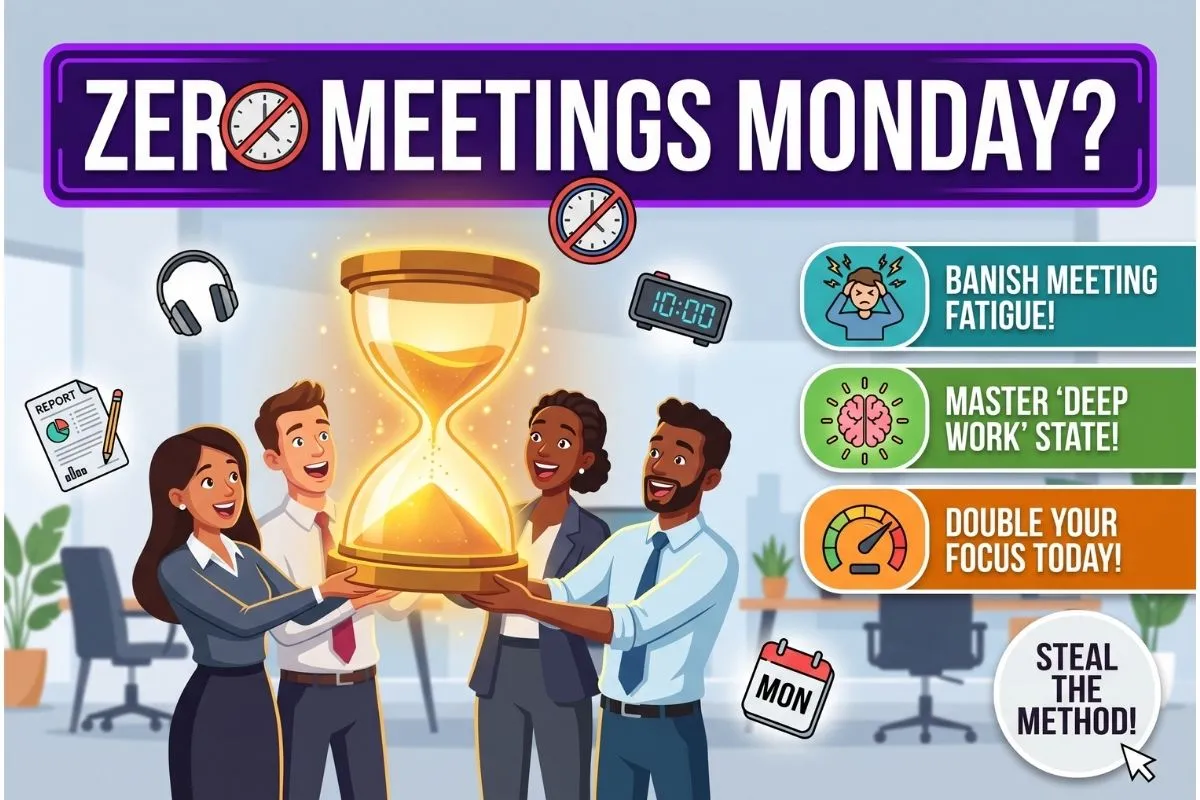
Picture this: It is Monday morning. You wake up, brew your coffee, and sit down at your desk. You open your calendar, bracing yourself for the usual visual assault of blue and red blocks stacked like a chaotic game of Tetris. But today is different. Your calendar is entirely blank. There is no 9:00 AM “weekly alignment,” no 10:30 AM “synergy sync,” and no 1:00 PM “brainstorming session” that inevitably derails your afternoon. Instead, there is just a vast, unbroken expanse of time stretching before you. You have not been fired, and the company has not gone under. You have simply entered the era of the “Async Monday,” a radical shift in workplace culture that is rapidly becoming the ultimate competitive advantage for modern businesses. This is not about working less; it is about working differently, reclaiming your cognitive bandwidth, and escaping the meeting doom-loop that plagues modern professionals.
The Anatomy of the Asynchronous Paradigm
The concept of an asynchronous—or “async”—workday is rooted in a beautifully simple premise: communication does not need to happen in real-time for work to move forward. In a traditional office environment, whether physical or virtual, we are conditioned to believe that presence equals productivity. If we are not actively talking to each other on a video call, we must not be working. An Async Monday shatters this illusion by enforcing a strict ban on internal meetings, real-time messaging expectations, and synchronous collaborations for the first day of the week. Instead of spending your morning giving verbal status updates that could have easily been a bulleted email, you spend it immersed in deep, uninterrupted thought. You review documents, write proposals, analyze data, and build strategies. When you do need to communicate, you do so thoughtfully through long-form written memos, recorded screen-shares, or meticulously updated project management boards. This approach is rapidly emerging as a foundational pillar for Startup growth 2026, as new companies realize that their most valuable resource is not how much their team talks, but how deeply their team can focus on complex problem-solving.
Surviving the Attention Economy
To understand why an Async Monday is so powerful, we have to look at the devastating toll that meetings take on our brains. We currently live in what researchers call the Attention economy, an environment where human attention is treated as a scarce commodity. Every time you are pulled out of a task to jump on a thirty-minute check-in call, you are not just losing thirty minutes of your day. You are suffering from “context switching,” a cognitive penalty that occurs when your brain is forced to abruptly pivot from one type of thinking to another. Studies suggest it can take up to twenty-three minutes to fully regain your focus after a single interruption. Therefore, a calendar sprinkled with three or four short meetings actually destroys the entire day’s potential for “deep work”—the state of distraction-free concentration that pushes your cognitive capabilities to their limits. By dedicating Monday entirely to asynchronous work, you are giving your brain the rare opportunity to enter a flow state, allowing you to tackle the most demanding, high-value tasks of your week when your energy reserves are at their highest.
Building the Engines of Revenue
So, what exactly do you do with this massive block of uninterrupted time? For forward-thinking teams, an Async Monday is not just for catching up on emails; it is the time used to build scalable systems that do the heavy lifting for the rest of the week. Consider a modern sales or marketing team. Instead of spending Monday morning in a draining pipeline review discussing last week’s numbers, a growth director can use those four uninterrupted hours to architect a sophisticated AI Lead Gen strategy. In complete silence, they can map out complex customer journeys, write persuasive copy, and train language models to identify high-intent prospects across the web. Because they are not being interrupted, they can effectively configure intricate B2B sales automation workflows that will run quietly in the background from Tuesday through Friday. By the time Tuesday morning rolls around and the first meetings finally occur, the team isn’t just talking about generating revenue; the automated systems built during the Async Monday have already spent the last twenty-four hours filling their pipelines. This is the difference between working in your business and working on your business.
The Cultural Shift Towards Written Clarity
Transitioning to an Async Monday requires a fundamental rewiring of your company’s communication culture, moving away from verbal convenience and toward written clarity. When you cannot simply hop on a quick call to explain a half-baked idea, you are forced to actually think it through. This is why highly asynchronous companies rely heavily on the written word. If you want to propose a new project on an Async Monday, you cannot rely on your charisma in a Zoom room to sell it. You have to sit down and write a clear, logically sound, and comprehensive document that anticipates questions and provides data-backed answers. This practice, famously championed by companies like Amazon with their “six-page memos,” inherently elevates the quality of thought across the entire organization. It democratizes the workplace, giving a voice to introverts who might be talked over in a loud meeting, and it creates a permanent, searchable archive of company decisions. Ultimately, the success of an Async Monday hinges on trusting your team to manage their own time and output, judging them on the actual work they deliver rather than the optical illusion of how busy they look on a webcam.
The Async Monday vs. The Traditional Monday
To visualize the impact of this shift, consider the stark contrast between a standard start to the week and an asynchronous one. The metrics below highlight how reclaiming your time directly correlates to reduced stress and higher output.
| Metric | Traditional Monday | Async Monday |
| Time in Meetings | 3.5 to 5 Hours | 0 Hours |
| Context Switches | 15+ per day | Minimal (Self-directed) |
| Deep Work Achieved | 45 – 90 Minutes | 4 to 6 Hours |
| End-of-Day Stress Level | High (Meeting fatigue) | Low to Moderate (Accomplished) |
| Primary Output | Status updates, consensus | Deep strategy, system building, focused execution |
| Communication Style | Reactive, verbal, immediate | Proactive, written, structured |
Frequently Asked Questions
What happens if there is a genuine emergency on an Async Monday? An Async Monday is not a communications blackout. Most teams implement an “escalation protocol.” Routine chat messages and emails are ignored, but if a server crashes or a major client has a crisis, there is a dedicated channel (like a specific phone number or a designated emergency pager app) that will break through the silence. True emergencies are rare; most things can wait until Tuesday.
Does this work for client-facing roles like sales or support? Yes, but it requires adaptation. Customer support might use rotating shifts so the business is always covered, while individual reps get their dedicated async time. For sales, Mondays are blocked off from internal team meetings, allowing reps to use the entire day to process Business process automation tools, draft personalized outreach, and conduct deep research on their prospects without internal distractions.
How do I convince my traditional boss to let me try this? Do not ask for a permanent policy change immediately. Pitch it as a one-month, low-risk experiment. Propose an “Async Monday Pilot” where you track your productivity and deliverables. Present them with the data at the end of the month showing that your output increased and your project timelines accelerated because you had uninterrupted focus time.
Won’t team culture and camaraderie suffer without regular check-ins? Interestingly, removing low-value status meetings often improves culture. Because people aren’t burnt out from forced Zoom interactions on Monday, they are actually more present, engaged, and enthusiastic when collaborative meetings happen on Tuesday or Wednesday. Culture is built through meaningful connection, not through staring at each other while reading a spreadsheet.
Curiosity Corner: The Evolution of the Workweek
It is easy to forget that the structure of our workweek is entirely invented. The five-day, forty-hour workweek was not handed down by nature; it was popularized by Henry Ford in 1926 to accommodate factory lines, and it was formalized into US law in 1940. We have spent the last century running modern, digital, knowledge-based businesses on a schedule designed for manufacturing physical cars. The rise of the Async Monday is simply the next evolutionary step. Just as the industrial revolution required us to be in the same physical place at the same time to operate machinery, the cognitive revolution of the 21st century requires us to protect our mental space to operate at our highest intellectual capacity. Skipping meetings isn’t slacking off; it is the ultimate respect for the modern craft of knowledge work.
