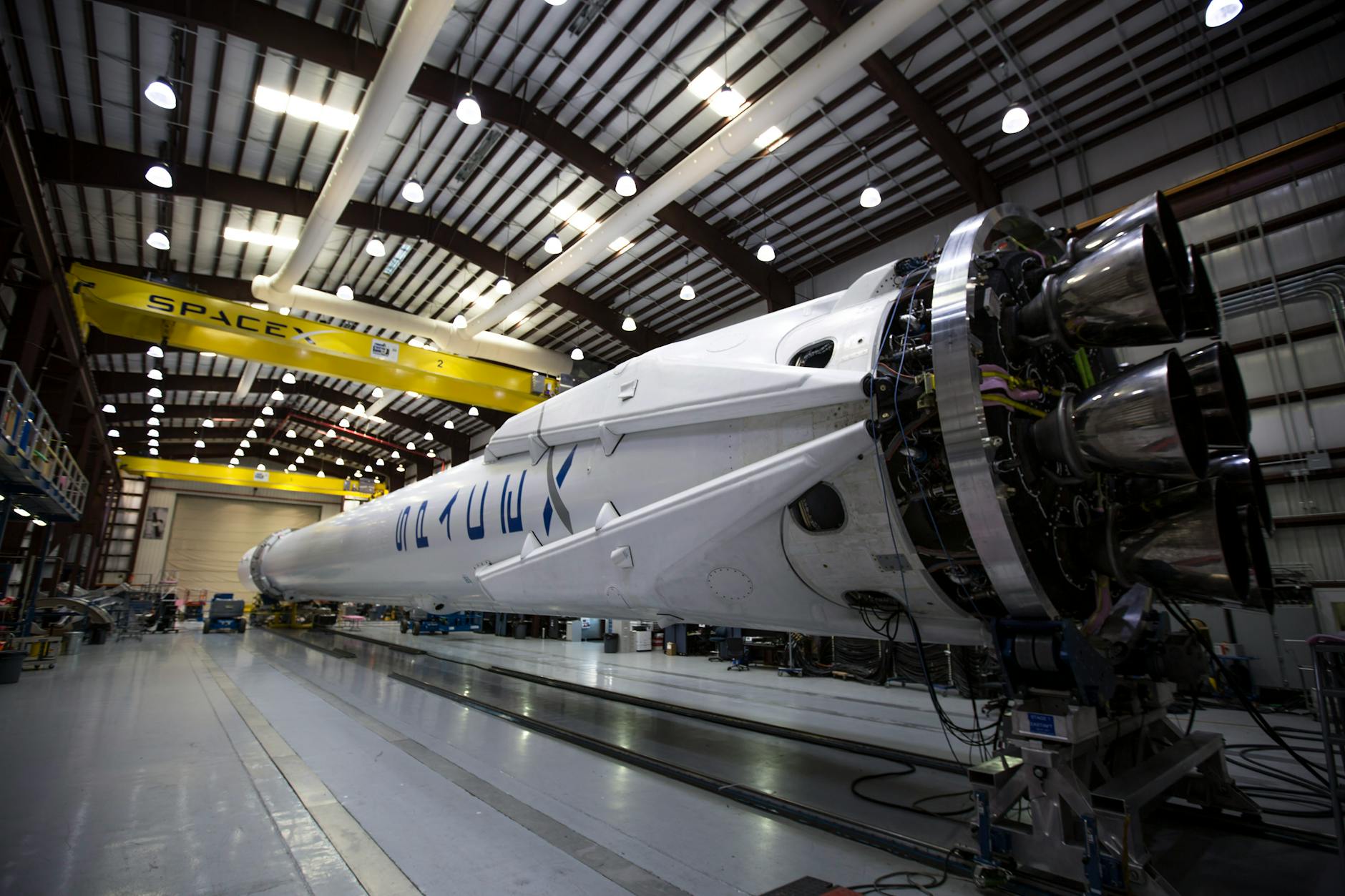
The relentless drumbeat of innovation coming from Space Exploration Technologies Corp., commonly known as SpaceX, continues to reshape the global technological landscape, often outpacing the attention paid by traditional market watchers. Another successful launch, this time ferrying 25 Starlink satellites aboard a veteran Falcon 9 rocket from Vandenberg Space Force Base, serves not just as a technical achievement but as a profound marker in the accelerating race for orbital dominance. When these orbital assets reach their operational altitude, they silently contribute to a sprawling network that is already beginning to pressure established sectors, from telecommunications giants to even consumer goods conglomerates like \*\*PepsiCo, Inc.\*\*, whose future distribution chains might one day rely on this ubiquitous connectivity. This latest launch is just one small cog in a much larger machine demonstrating the sheer operational velocity SpaceX commands in the burgeoning commercial space sector.
The Unstoppable Velocity of the Starlink Machine
This particular mission, the 25th supporting the Starlink constellation this year alone, underscores a manufacturing and launch cadence that traditional aerospace companies struggle to even comprehend, let alone match. To consistently put dozens of sophisticated satellites into Low Earth Orbit requires not only reliable hardware but a standardized, repeatable process that functions with near-factory precision. The fact that the first stage booster, designated B1071, successfully completed its 32nd flight and returned for another drone ship landing highlights the immense strides made in rocketry reusability. This operational tempo drastically reduces the marginal cost of accessing space, which is the fundamental disruptive force underpinning the entire Starlink project. We are watching the maturation of a truly industrialized space operation, moving from bespoke assembly to repeatable, high-volume deployment. This constant flow of connectivity into orbit has immediate implications for terrestrial markets. While most eyes track the gigabit speeds delivered to remote farms or naval vessels, the ripple effect flows much deeper into the global economy. Think about the supply chain optimizations that rely on instant, high-bandwidth communication across continents. Companies managing vast logistics networks, far removed from traditional telecom infrastructure, are the first beneficiaries. This improved data throughput affects everything from automated port operations to granular tracking of perishable goods, which is an operational reality that giants like \*\*PepsiCo, Inc.\*\* must account for as they optimize their global sourcing and delivery metrics. The latency reduction in remote areas alone can unlock previously untapped markets, creating economic activity that didn’t exist before the satellites were there. The scale of the current Starlink deployment is staggering. Each successful launch pushes the total fleet size higher, increasing network redundancy and boosting overall capacity. This relentless build-out creates an economic moat around SpaceX, making it increasingly difficult for any competitor, whether state-sponsored or private, to catch up to the sheer coverage area and bandwidth capacity already established in LEO. This isn’t just about launching rockets; it’s about establishing the definitive communications backbone for the next generation of global commerce, weather monitoring, and military applications. The speed at which this infrastructure is being laid down is arguably the most significant commercial development in orbital mechanics we have seen since the dawn of the satellite age decades ago.
Historical Echoes: From Apollo to Orbital Factories
To fully grasp the magnitude of SpaceX’s current schedule, one must look back at the space race era. In the 1960s, a single mission, often taking years of planning and requiring massive government expenditure, was considered a monumental achievement. Saturn V launches were infrequent and incredibly costly, reflecting a world where every rocket was treated as a one-time, custom-built artifact. The incredible feat of landing a booster just minutes after deploying 25 commercial satellites marks a paradigm shift away from that expensive, slow model. We have moved from bespoke government science projects to routine, commercially viable logistics execution. Contrast this with the initial stages of private satellite deployment. Early satellite internet ventures struggled mightily with launch costs and deployment rates, often relying on international partners or older, less efficient launch vehicles. The barrier to entry for establishing a global constellation was prohibitively high, reserved only for those with nearly infinite pockets and decades-long timelines. SpaceX, through rigorous iteration and the obsessive pursuit of reusability, has effectively bulldozed that barrier. The Falcon 9 booster B1071 flying its 32nd mission is proof that orbital access is now a service, not a project, fundamentally altering the economic assumptions for any company hoping to leverage space assets. This technological evolution mirrors rapid industrial revolutions of the past, such as the advent of mass production in the automotive industry. When Henry Ford figured out the assembly line, it democratized the automobile, transforming society and creating ancillary industries almost overnight. SpaceX is applying assembly-line thinking to the most complex machine building on Earth—a rocket—and then doing the same for the satellites themselves. This democratization of launch capability fuels downstream innovation across sectors, affecting industries as seemingly disparate as agriculture technology, remote medical diagnostics, and, surprisingly, the high-volume logistics handled by global food and beverage corporations.
The Economic Calculus of Reusability and Market Disruption
The true genius behind the current launch success lies in the repeated landing of the booster. The recovery of the first stage drastically slashes refurbishment time and material costs, turning a colossal expense into a manageable operational overhead. When a booster lands safely on a drone ship like ‘Of Course I Still Love You,’ the immediate financial saving is realized, but the long-term strategic value is even greater. It primes the rocket for its next mission in weeks, not months, fueling the sustained operational velocity required for an LEO constellation. This relentless cycle transforms the physics of orbital mechanics into a predictable economic input. This cost structure means SpaceX can effectively undercut every competitor still relying solely on expendable rocketry. This pricing power pressures global launch providers and forces established aerospace defense contractors to rapidly pivot toward developing their own reusable systems, often struggling to adopt the lean manufacturing principles pioneered by Elon Musk’s aerospace firm. The resulting competitive pressure in the launch services market is creating price deflation, which benefits all satellite operators, regardless of whether they use Starlink or a competitor for placement. It democratizes access to space for smaller nations, research institutions, and startups that could never afford legacy pricing structures. Furthermore, the baked-in redundancy of the Starlink fleet itself—with high satellite counts and frequent replacements—ensures service continuity. If an older satellite fails, a replacement is already planned, or perhaps already in the queue for the next launch window. This reliability is crucial for embedding the service into mission-critical infrastructure worldwide. Corporations need assurances that their connectivity won’t fail because of a single hardware malfunction. This level of systemic redundancy is something that legacy telecom providers, reliant on geographically distant, massive infrastructure, often cannot easily replicate in areas where Starlink is deployed.
The Hidden Vectors: How Space Impacts CPG Giants
It might seem a vast leap to connect a Falcon 9 launch to the operational strategy of a consumer packaged goods powerhouse like \*\*PepsiCo, Inc.\*\* However, the modern supply chain is entirely digitized and latency-sensitive. The ability for \*\*PepsiCo, Inc.\*\* to manage inventory, track point-of-sale data in real-time across developing markets, and automate warehousing relies heavily on stable, high-speed internet—often in locations where fiber optics haven’t reached. Starlink bypasses these terrestrial limitations, providing a low-latency bridge for critical operational data from the most remote distribution centers directly to corporate headquarters. As Starlink coverage blankets more of the globe, it enables faster adoption of advanced logistics software in regions previously deemed too inaccessible or too costly to upgrade with traditional infrastructure. This increased efficiency translates directly to lower operational costs, better inventory rotation minimizing spoilage, and the ability to execute just-in-time fulfillment at a global scale. The intangible benefit here is reduced systemic risk within a complex global operation. A major outage in a key regional hub due to aging terrestrial infrastructure can be instantly mitigated by routing critical data traffic over the LEO constellation. This resilience is an increasingly valuable commodity. The market psychology surrounding this connectivity also plays a role in investment decisions. Investors are increasingly favoring companies that demonstrate agility and technological integration across their entire value chain. A corporation demonstrably leveraging cutting-edge infrastructure, whether it is next-gen robotic fulfillment or ubiquitous satellite connectivity, signals forward-thinking management superior to peers stuck relying on decade-old telecom contracts. This creates a subtle, yet persistent, pressure on every major player to embrace these new space-enabled efficiencies to maintain their valuation premium.
Future Trajectories: Three Paths for Orbital Dominance
Looking ahead, the trajectory set by these frequent launches suggests several high-stakes possibilities for the market. The first scenario involves rapid market saturation: SpaceX achieves comprehensive global coverage faster than anticipated, effectively locking in the dominant market share for LEO broadband connectivity for the next decade. This forces competitors to focus on niche, highly specialized orbital slots or develop entirely new technologies, perhaps focused on high-altitude platforms or direct-to-device messaging, rather than competing head-to-head on general connectivity speeds. The second plausible path involves a significant operational pivot toward non-Starlink payloads. As the Starlink constellation matures and requires fewer additions, SpaceX’s substantial launch cadence could be redirected toward other high-value clients, including government agencies or deep-space exploration partners. This diversification would signal the transition of SpaceX from a satellite deployment company into the preeminent, low-cost global launch utility, capable of handling anything from micro-satellites to heavy lift payloads destined for the Moon or Mars, further solidifying their unassailable position in the launch services sector. The final, and perhaps most disruptive, scenario involves the integration of Starlink directly into consumer and enterprise products in radical ways. Imagine autonomous vehicles built to traverse the remotest roads, relying solely on Starlink for V2X communication, or IoT devices streaming environmental data from previously unreachable locations like deep-sea sensors or polar research stations. This seamless integration would transform connectivity from a utility provided by a telecom company into an assumed feature of any advanced piece of hardware, fundamentally shifting the competitive dynamics for every company building hardware that relies on data transfer, from aerospace manufacturers to the engineers designing the next fleet of delivery vans for global food distribution networks. The constant stream of launches ensures that this future remains perpetually within arm’s reach.
FAQ
What demonstrated the operational velocity of SpaceX in this specific launch event?
The successful deployment of 25 Starlink satellites using a veteran Falcon 9 rocket, designated B1071, showcased the company’s rapid cadence. This mission was the 25th Starlink launch supporting the constellation that year alone, indicating a standardized, repeatable process.
How many previous flights had the Falcon 9 booster B1071 completed before this mission?
The article explicitly states that the first stage booster, B1071, successfully completed its 32nd flight during this mission. This successful landing underscores the massive strides achieved in realizing reliable rocket reusability.
How does SpaceX’s current manufacturing and launch cadence contrast with the historical Apollo era launches?
In the 1960s, a single Saturn V mission required years of planning and massive government spending, treating each rocket as a costly, one-time artifact. SpaceX has moved away from this bespoke model to routine, commercially viable logistics execution.
Which major consumer packaged goods (CPG) company is cited as an example impacted by Starlink’s connectivity improvements?
The article frequently cites PepsiCo, Inc. as a relevant example of a company whose future distribution chains and logistics optimizations will rely on ubiquitous connectivity. This connectivity allows PepsiCo to better manage global sourcing and delivery metrics.
What is the fundamental economic driver underpinning the entire Starlink project?
The fundamental driver is the drastic reduction in the marginal cost of accessing space, achieved through rocketry reusability. This allows for high-volume deployment that traditional models could not sustain.
In what way does the current scale of the Starlink deployment create an economic moat around SpaceX?
The sheer volume of successful launches increases network redundancy and overall bandwidth capacity established in Low Earth Orbit (LEO). This established footprint makes it extremely difficult for any competitor to catch up in terms of coverage area.
Beyond consumer broadband, what deeper terrestrial markets are immediately affected by Starlink’s latency reduction?
The improved data throughput directly benefits companies managing vast logistics networks, enabling better supply chain optimizations across continents. Furthermore, it unlocks previously untapped markets in remote areas requiring high-bandwidth communication.
What historical industrial revolution does the article compare SpaceX’s manufacturing approach to?
The article compares SpaceX’s application of assembly-line thinking to rocket building to the advent of mass production in the automotive industry, citing Henry Ford. This industrialization democratizes access to space capability.
What financial implication does the recovery of the first-stage booster have on operations?
Recovery drastically slashes refurbishment time and material costs, transforming what was a colossal expense into manageable operational overhead. The booster can be primed for its next mission in weeks rather than taking many months.
How does Starlink’s service continuity benefit mission-critical infrastructure?
The high satellite count and frequent replacement schedule ensure systemic redundancy, meaning the failure of one satellite does not cause a service outage. This reliability is crucial for embedding the service into infrastructure that cannot tolerate failure.
What is the first trajectory scenario for future orbital dominance mentioned by the article?
The first scenario involves rapid market saturation, where SpaceX achieves near-comprehensive global coverage ahead of schedule. This effectively locks in the dominant market share for general LEO broadband connectivity for the coming decade.
What is the second plausible future trajectory for SpaceX’s operational focus?
The second path involves a significant operational pivot toward payloads other than Starlink once the constellation matures and requires fewer additions. This would transition SpaceX into the preeminent, low-cost global launch utility for government and deep-space partners.
What is the final, most disruptive scenario projected for Starlink integration?
The final scenario involves the seamless integration of Starlink directly into advanced hardware, such as autonomous vehicles or remote IoT devices like deep-sea sensors. Connectivity would become an assumed feature of the hardware itself, rather than a service supplied by a telecom provider.
How does the reliance on Starlink reduce systemic risk for global corporations like PepsiCo?
By providing a low-latency bridge for critical operational data, Starlink bypasses the vulnerability of aging or non-existent terrestrial infrastructure in remote distribution hubs. This resilience is an increasingly valuable commodity during regional outages.
What is the strategic advantage gained by SpaceX establishing its network so rapidly?
The rapid deployment of this infrastructure establishes significant barriers to entry, making it increasingly difficult for state-sponsored or private competitors to match the established coverage area and bandwidth capacity in LEO.
How does the competitive pressure from SpaceX’s pricing affect the launch services market generally?
SpaceX’s cost structure, enabled by reusability, allows it to undercut competitors relying solely on expendable rocketry. This forces established aerospace defense contractors to rapidly adopt reusable systems, leading to overall price deflation for all satellite operators.
What intangible benefit does leveraging new space technology provide concerning investment decisions?
Corporations demonstrating agility by leveraging cutting-edge infrastructure signals forward-thinking management to investors. This creates persistent pressure on their peers to adopt similar space-enabled efficiencies to maintain competitive valuation premiums.
What specific type of communication reliance for autonomous vehicles is mentioned in the future trajectory section?
The article suggests that autonomous vehicles traversing the most remote roads could rely solely on Starlink for Vehicle-to-Everything (V2X) communication. This ensures necessary data transfer where traditional infrastructure is unavailable.
Why is the operational tempo of SpaceX so difficult for traditional aerospace companies to match?
Traditional aerospace firms struggle because they lack the standardized, repeatable process SpaceX has developed, which functions instead with near-factory precision. They are often not built for the lean manufacturing principles SpaceX champions.
How does Starlink’s service specifically empower logistics for perishable goods?
The reduced latency provided by ubiquitous LEO connectivity allows for granular, real-time tracking of perishable goods across continents. This improved data throughput enables better inventory rotation and minimizes spoilage rates in global delivery networks.
What does the shift from bespoke satellite deployment models imply for the future of orbital access?
The shift implies that orbital access is now codified as a reliable, commercially viable service rather than an expensive, decades-long government project. Through rigorous iteration on reusability, SpaceX has bulldozed the previously high barrier to entry.