
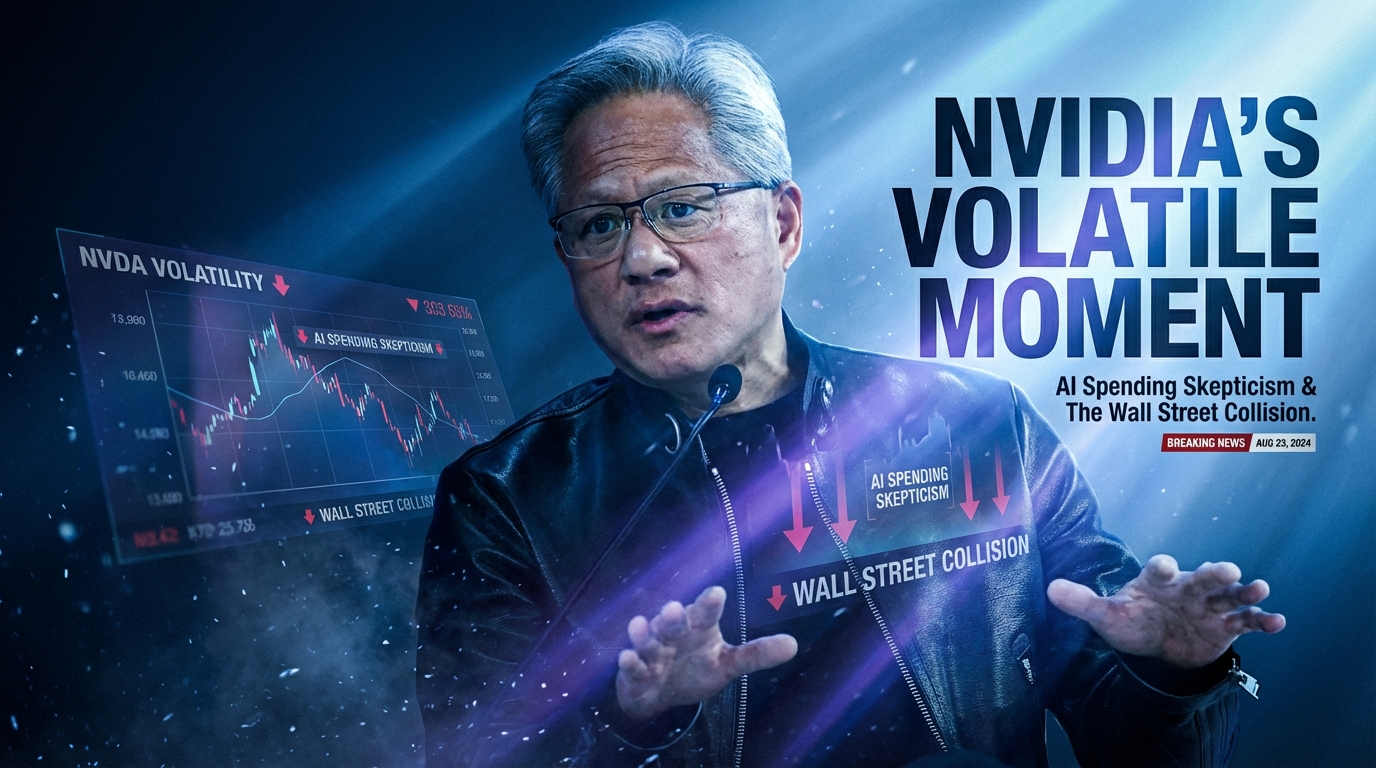
The air around NVIDIA is thicker than the silicon fumes in a packed data center. As the world’s most valuable publicly traded company gears up for its quarterly earnings release, the scrutiny is intense, bordering on suffocating. This isn’t just about another quarterly report; it’s a referendum on the sustainability of the entire artificial intelligence boom. Investor sentiment is a tightrope act: on one side, undeniable, massive revenue growth fueled by the insatiable appetite of the hyperscalers; on the other, the creeping fear of a monumental spending pullback that could send the colossal chipmaker tumbling. The upcoming date is not just a fixture on the financial calendar; it is a high-stakes juncture where market certainty meets deep-seated technological anxiety.
The Quiet Outperformance Amidst Tech Turmoil
While the broader technology sector has been shedding significant weight to start this year, with giants like Microsoft, Amazon, and Tesla experiencing double-digit pullbacks, NVIDIA has stubbornly remained aloft, even registering modest gains. This divergence in performance is the first key indicator of just how much institutional money is tethered to the fate of this single entity. When seven out of eight trillion-dollar tech titans stumble, and the one that doesn’t is the foundational supplier for the whole ecosystem, attention naturally focuses on its operational health. The recent performance suggests that pre-earnings positioning is weighted toward the bulls, trusting that NVIDIA’s data center revenue stream is sufficiently insulated from the market’s general malaise.
The data confirms the narrative of gravitational pull. NVIDIA’s core business, the data center segment, is reportedly generating approximately 90% of its total revenue. This hyper-concentration means that any shift in capital expenditure strategy by the four leading hyperscalers—Alphabet, Microsoft, Meta, and Amazon—translates directly and powerfully onto NVIDIA’s top line. These titans are forecasted to collectively pour nearly $700 billion into AI infrastructure this year alone, representing an approximate 60% increase in capital spending over the historic highs set just last year. This is not conventional business expansion; this is an arms race being funded by seemingly limitless capital, and NVIDIA holds the monopoly on the crucial weaponry.
Analysts, led by firms like Wedbush Securities, are overwhelmingly recommending a buy, pointing to forecasts that suggest AI infrastructure spending will actually outpace general capital expenditure trends. The underlying conviction is that even if overall IT budgets tighten slightly, the generative AI flywheel necessitates continued, if not accelerated, investment in the specialized hardware required to both train and run large language models. The narrative is straightforward: AI hunger is not satiated, and NVIDIA currently possesses the only hardware capable of feeding it at scale. This bullish positioning is reflected in price targets that still offer substantial upside, suggesting the market expects the quarterly report to confirm this sustained momentum.
The Shadow of Overbuilding and Peak Capex Skepticism
Despite the roaring revenue forecasts, a profound skepticism permeates the periphery of the AI investment theme. This is the critical counterpoint that keeps the earnings call appointment crucial. The fear isn’t that NVIDIA is failing now, but that the current build-out represents a temporary, unsustainable surge—a classic boom that precedes an inevitable bust, or at minimum, a severe normalization. The primary concern crystallized by analysts at Cantor Fitzgerald revolves around the perception of “peaking hyperscale capex” within the current year.
If the major cloud providers have already purchased enough of the current generation of high-powered GPUs to satisfy immediate training demands, the subsequent quarters could reveal a deceleration in orders. This slowdown wouldn’t necessarily mean reduced profits in the short term, given the massive backlog and current demand, but it would severely impact future revenue growth projections, which are currently priced for perpetuity. The sheer scale of the projected $66 billion revenue for the last reported fiscal quarter, and $72 billion anticipated for the upcoming April quarter, places an immense burden of proof on management to demonstrate that this growth trajectory is structurally sound, not just cyclically explosive.
Market watchers will be hunting for any nuance in management’s commentary that suggests a flattening of the order book or a shift in buying patterns among the major clients. The reliance on these four hyperscalers creates a classic single point of failure risk. Should one of them decide to slow expansion due to macroeconomic pressures or internal optimization cycles, the effect on NVIDIA’s financial statements would be immediate and disproportionate, precisely because the company has built itself around servicing these colossal, synchronized capital expenditure programs. This inherent risk is why even the most bullish analysts hedge their optimism with cautionary notes regarding near-term demand ceiling risks.
Historical Echoes: Dot-Com Mania vs. Infrastructure Reality
To truly understand the current high-wire act, one must look back at the early 2000s dot-com bubble. During that era, telecommunications and internet infrastructure companies saw valuations decouple entirely from tangible earnings, fueled by speculation about future connectivity. We witnessed massive overbuilds in fiber optics and networking equipment, followed by a brutal correction when that speculative demand failed to materialize instantly. While today’s AI spending is arguably underpinned by more concrete, immediate utility—the actual deployment of AI services—the velocity of the capital deployment bears an unsettling resemblance.
However, the crucial difference lies in the product itself. During the dot-com bust, the infrastructure was often built on unproven business models. Today, the GPUs being purchased are immediately deployed to generate data, refine models, and power revenue-generating applications like advanced search, coding assistants, and enterprise automation. This fundamental utility gives the current spending cycle a much stronger economic foundation than 1999’s speculative frenzy. The demand is tangible, directly contributing to customer productivity and monetization strategies, making the potential crash less about obsolescence and more about absorption rates.
Furthermore, the historical context of semiconductor cycles must be acknowledged. The industry is notoriously cyclical, operating on multi-year upgrade paths tied to process node advancements and new architectural designs. NVIDIA is currently dominating the transition to advanced packaging and the specific needs of deep learning workloads. Previous semiconductor cycles often saw massive inventory buildups that led to multi-quarter digestive periods. The current situation hinges on whether the demand for the next-generation chip, like the forthcoming Vera Rubin systems, can immediately mop up the output from the current H100/H200 generation, preventing a glut that would depress pricing for existing inventory.
Decoding the Roadmap: Vera Rubin and Strategic Acquisitions
The technical substance of NVIDIA’s defense against cyclical downturn lies in its product roadmap and strategic acquisitions, the very details investors will press for on the earnings call. CEO Jensen Huang has painted a picture of relentless technological evolution, noting that between the current Blackwell architecture and the upcoming Vera Rubin rack-scale systems, NVIDIA anticipates $500 billion in gross GPU sales. This forward projection isn’t just about releasing a better chip; it’s about maintaining an architecture lead that necessitates continuous, massive capital reinvestment from customers.
The Vera Rubin rollout, expected later this year, represents the next major inflection point. Investors need assurance that the architecture transition will be smooth and that the new product will command premium pricing and immediate adoption, preventing the dreaded “inventory overhang” that plagued other hardware manufacturers in past cycles. If customers perceive the Rubin launch as only a marginal improvement over the existing fleet, they might slightly delay purchases, creating the exact slowdown the skeptics are anticipating.
A significant new variable in this earnings report involves the recent $20 billion acquisition of assets from chip startup Groq. Groq specializes in the inference side of the AI equation—the real-time application of trained models—whereas NVIDIA has historically dominated the training phase. Bringing in Groq’s expertise, and its key leadership, signals NVIDIA’s intent to firewall itself against fragmentation in the AI stack. The market is keenly interested in how this inference technology will be integrated and, more importantly, how it will be used to counter the rising threat of custom Application-Specific Integrated Circuits, or ASICs, being developed in-house by competitors like Google and Amazon to reduce reliance on external vendors.
Analysts expect a detailed strategy regarding the Groq integration, hoping that this move will enhance NVIDIA’s accelerator portfolio and effectively mitigate concerns about losing ground to custom silicon solutions. If Huang can articulate a clear, revenue-generating roadmap for the Groq team that directly leverages their inference capabilities to lock in more developer ecosystems, it provides a powerful counter-argument to the ASIC threat, solidifying the moat around their core business proposition. The strength of the \*\*Paper\*\* trail regarding technological advancement is what buys credibility for future spending.
Future Scenarios: Navigating the Trough of Disillusionment
Looking beyond the immediate quarterly numbers, investors must weigh three distinct future possibilities, each dramatically reshaping the valuation landscape for the world’s current chip leader. The first, and most optimistic, scenario is the “Perpetual Ascent,” where AI adoption continues to outpace hardware capacity. In this reality, the hyperscalers’ capital expenditures remain robust through the end of the year, driven by real-world monetization of generative AI, and the Vera Rubin launch hits peak demand instantly. NVIDIA’s revenue growth, though decelerating slightly from stratospheric levels, remains firmly in the double digits, and the acquisition of Groq proves to be a masterstroke in preempting competitive threats.
The second scenario is the “Inventory Correction,” the most feared outcome. If hyperscalers deem their current data center build-out sufficient for the near term, or if economic headwinds force them to tighten discretionary large capital projects, orders for new hardware slow abruptly. This doesn’t imply a complete halt to AI development, but certainly a multi-quarter pause while existing capacity is fully utilized. For NVIDIA, this means growth rates might fall into the 30-40% range, a phenomenal figure for any company but a significant disappointment for one priced for perfection. This scenario would likely trigger a substantial re-rating of the stock price as the market aggressively discounts future growth embedded in the current valuation \*\*Paper\*\*.
The third, more nuanced, outcome is the “Strategic Diversification.” In this path, while the hyperscalers consolidate spending, NVIDIA successfully pivots to new, massive markets. This could involve surging demand from aerospace, automotive autonomous driving platforms, or significant government/defense contracts that require high-end processing power. If management can demonstrate tangible revenue traction from markets outside the immediate cloud computing sphere, it fundamentally de-risks the business model from over-reliance on the four giants. This diversification would appease skeptics concerned about the AI spending ceiling, providing a new, high-growth vector to justify premium multiples moving into the next fiscal cycle.
Ultimately, the earnings report will serve not just as a scorecard for the past three months, but as a crucial signpost for the next eighteen. NVIDIA’s dominance is undeniable, but that dominance is predicated on the assumption that the global appetite for accelerated computing remains insatiable and that the company can perpetually out-innovate competitors and manage the inherent cyclicality of massive capital deployment. The market is holding its breath, awaiting the precise flavor of bullish clarity or cautionary ambiguity.
FAQ
What is the primary market concern underpinning the intense scrutiny of NVIDIA’s upcoming earnings report?
The primary concern is the sustainability of the massive AI boom and whether the colossal chipmaker faces a monumental spending pullback from its hyperscaler customers. This pressure tests whether current growth is structurally sound or merely a cyclical surge in capital expenditure.
Why has NVIDIA’s stock performance diverged positively from the broader technology sector recently?
This divergence suggests that significant institutional money is tethered directly to NVIDIA, viewing its data center revenue stream as insulated from general tech sector malaise. Its foundational role in the AI ecosystem makes it a primary focus, irrespective of turbulence elsewhere.’]},{
What percentage of NVIDIA’s total revenue is reportedly derived from the data center segment?
The data center segment is reported to be generating approximately 90% of NVIDIA’s total revenue. This hyper-concentration means that shifts in the four leading hyperscalers’ strategies have an immediate and powerful impact on NVIDIA’s top line.
How much capital are the four leading hyperscalers forecasted to spend on AI infrastructure this year?
The four titans—Alphabet, Microsoft, Meta, and Amazon—are forecasted to collectively spend nearly $700 billion on AI infrastructure this year. This represents an approximate 60% increase in capital spending compared to the previous year’s historic highs.
What is the main reason analysts maintain a strong ‘buy’ recommendation despite growth acceleration fears?
Analysts believe that the generative AI flywheel necessitates continued, even accelerated, investment in the specialized hardware needed for both training and running large language models. They assert that AI hunger is not yet satiated, and NVIDIA holds the current monopoly on necessary scale hardware.
What specific fear causes skepticism regarding the long-term viability of current hyperscale Capex?
The skepticism revolves around the perception of ‘peaking hyperscale capex’ within the current year, suggesting that major cloud providers may have already purchased enough GPUs for immediate needs. If this slowdown occurs, it severely impacts future revenue growth projections currently priced for perpetuity.
How do the projected revenues for the upcoming April quarter put pressure on NVIDIA’s management?
With projections anticipated around $72 billion for the April quarter following a reported $66 billion last quarter, management faces an immense burden of proof. They must demonstrate that this trajectory is structurally sound rather than just a temporary, cyclical explosion of spending.
What is the inherent single point of failure risk in NVIDIA’s current business concentration?
The risk is the extreme reliance on the capital expenditure programs of just four major hyperscalers. If one of these key clients slows expansion due to macro pressures or optimization cycles, the effect on NVIDIA’s financials would be immediate and disproportionate.
How does the current AI spending cycle compare structurally to the dot-com bubble overbuilds?
While the velocity of capital deployment seems similar to the dot-com era, today’s spending is underpinned by tangible utility in deploying revenue-generating AI services. This fundamental utility gives the current cycle a stronger economic foundation than the speculative mania of the early 2000s.
Besides immediate AI demand, what historical factor influences NVIDIA’s cycle, related to hardware evolution?
The industry is notoriously cyclical, often operating on multi-year upgrade paths tied to process node advancements and new architectural designs. The current situation depends on whether demand for the next-generation chip can immediately absorb the output of current generations to prevent inventory glut.
What is the significance of the projected $500 billion in gross GPU sales mentioned by CEO Jensen Huang?
This massive forward projection, spanning the current Blackwell architecture to the upcoming Vera Rubin systems, serves as a defense against cyclical fears. It signals NVIDIA’s intent to maintain an architectural lead requiring continuous, massive capital reinvestment from customers.
What assurance do investors need regarding the upcoming Vera Rubin system launch?
Investors require assurance that the architecture transition will be seamless and that the new product will command premium pricing and immediate adoption. A perception of only marginal improvement could cause customers to delay purchases, triggering the feared slowdown.
How does the acquisition of Groq assets change NVIDIA’s strategic position in the AI stack?
Groq specializes in the inference side of AI (real-time application), complementing NVIDIA’s historical dominance in model training. This move signals an intent to fight fragmentation and mitigate competition from custom ASICs developed by rivals.
What is the market looking for regarding the integration of Groq technology?
The market expects a detailed, revenue-generating roadmap for the Groq team that leverages their inference capabilities. A successful integration should lock in more developer ecosystems and solidify the competitive moat against custom silicon.
What is the ‘Perpetual Ascent’ scenario for NVIDIA’s future performance?
In this optimistic view, AI adoption continuously outpaces hardware capacity, hyperscalers maintain robust Capex, and the Vera Rubin launch captures peak demand instantly. This sustains double-digit revenue growth, validating current stock valuation.
What defines the ‘Inventory Correction’ scenario, and what is its impact on valuation?
This feared scenario involves hyperscalers pausing hardware orders after sufficient build-out, leading to a multi-quarter slowdown where growth might fall into the 30-40% range. This would likely trigger a substantial re-rating as the market aggressively discounts high future growth expectations.
What does the ‘Strategic Diversification’ outcome require from NVIDIA’s management to satisfy skeptics?
Management must demonstrate tangible revenue traction from significant markets outside of the immediate cloud computing sphere, such as aerospace, automotive, or defense contracts. Success here fundamentally de-risks the business model from over-reliance on the four giant cloud providers.
What is the role of the hyperscalers’ $700 billion infrastructure spending in shaping current market reality?
This massive, race-like spending signifies the immediate, tangible demand for AI acceleration hardware that NVIDIA currently monopolizes. It confirms that the foundational layer of the AI boom is heavily funded and actively building out capacity.
Why is the ‘Paper’ trail of technological advancement crucial for justifying future spending?
The ‘Paper’ trail refers to the documented roadmap and clear articulation of technological advancements, like the transition to Vera Rubin systems. This documentation is essential for convincing customers to commit to continuous, massive capital expenditures rather than pausing.
How does NVIDIA’s current market position differ from companies during the dot-com bust regarding product viability?
During the dot-com correction, infrastructure often served unproven business models, but today’s GPUs are immediately deployed to power revenue-generating applications like coding assistants and enterprises automation. The demand has direct, visible productivity benefits.
What specific kind of revenue deceleration would constitute a disappointment for a stock priced for perfection?
While 30-40% growth is excellent for most companies, it would be a significant disappointment for NVIDIA if the market expects sustained rates far exceeding those figures due to its current high valuation and growth pricing. This gap triggers the re-rating risk.
