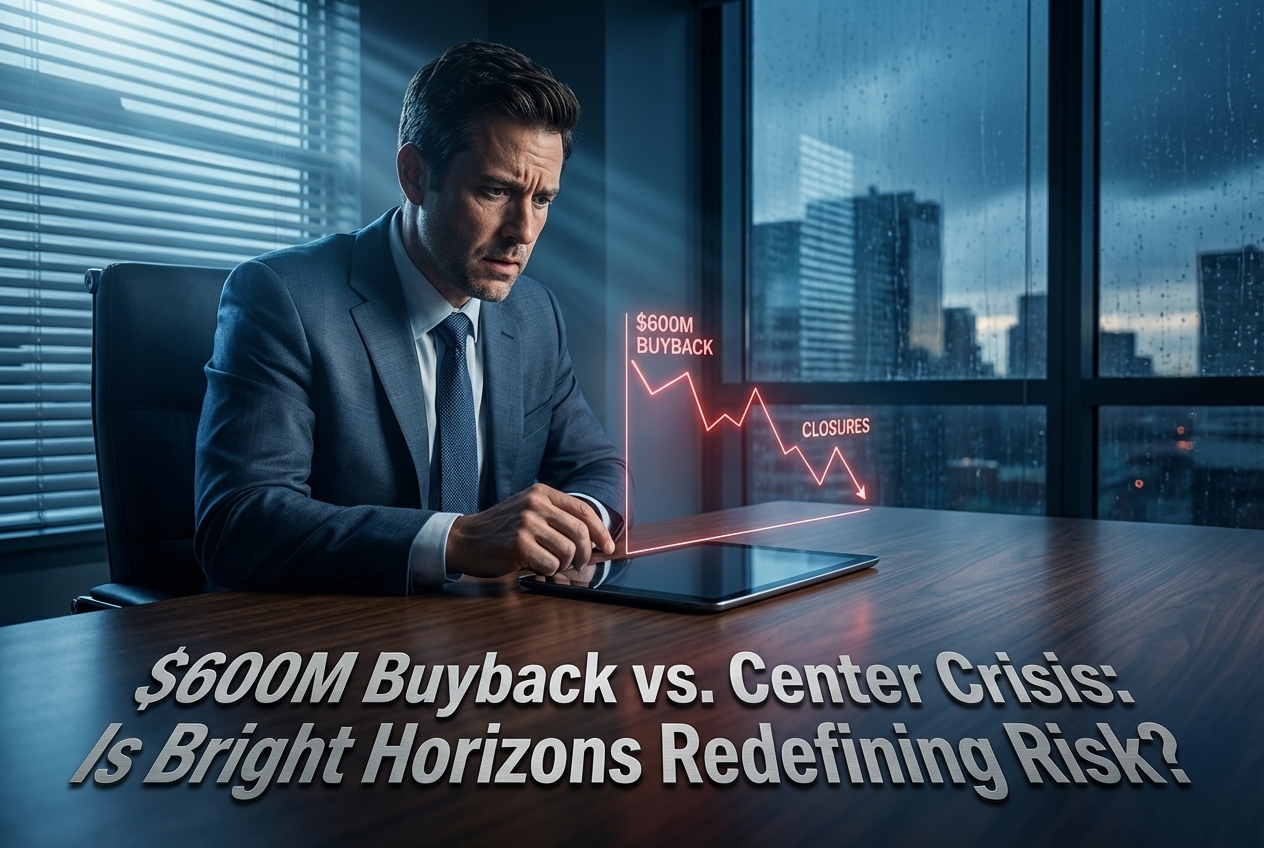
The Massive Repurchase Program Clashes Head-On with Operational Contraction
The financial markets are witnessing a fascinating, albeit nerve-wracking, maneuver from Bright Horizons Family Solutions. Fresh off disappointing performance metrics, the company has aggressively authorized a new share repurchase program valued at an eye-watering US$600 million. This isn’t just corporate boilerplate; it’s a massive vote of confidence—or perhaps a desperate measure—aimed squarely at shareholders. What makes this seismic announcement so compelling, and potentially alarming, is its direct juxtaposition against a severe operational retrenchment. Reports indicate that management is dramatically increasing the pace of full-service center closures for the fiscal year 2026, nearly doubling previous expectations. This financial engineering is a loud signal to the investment community: management believes the inherent value of the remaining business, particularly its employer-sponsored and back-up care segments, significantly outweighs the current market discounting. But when a company retires billions in stock while simultaneously shuttering physical locations, investors are forced to ask tough questions about the sustainability of its core growth engine.
This strategic pivot toward leveraging capital for buybacks rather than reinvesting heavily in the existing brick-and-mortar footprint suggests a fundamental shift in capital allocation philosophy. The prior authorization for buybacks has already successfully concluded, reinforcing a commitment to return capital. Now, armed with this fresh $600 million mandate, Bright Horizons is essentially betting that the value accretion from shrinking the outstanding share count will outperform the immediate revenue drag caused by rationalizing the physical asset base. The data points are stark: weaker-than-expected fourth quarter results from 2025 have already cast a shadow, indicating underlying stress in enrollment or cost management. Layer onto that the legal overhang created by mounting securities fraud investigations initiated by law firms, and the picture becomes murkier. Investors are left trying to decode whether this buyback is a stabilizing anchor or a distraction from deeper structural flaws in the childcare services model.
The immediate impact of this news on the investment narrative cannot be overstated. For those holding the stock, the buyback provides a psychological floor, suggesting management sees significant undervaluation. It acts as a form of valuation support, reducing the per-share earnings burden even as absolute earnings projections might dip due to restructuring costs. However, for growth-focused investors, the concurrent announcement of 45 to 50 full-service center closures in 2026 signals contraction, not expansion. This suggests a painful, accelerated transition toward a leaner organizational structure heavily weighted toward the more flexible, higher-margin back-up care offerings. The critical metric moving forward will be managing these closures; any unexpected deterioration in enrollment rates at the remaining centers, or unexpected costs associated with exiting leases, will rapidly undermine the perceived benefit of the announced capital return program. The market seeks clarity on whether the savings from these exits will quickly offset the immediate operational headwinds.
Historical Context: Buybacks During Times of Distress and Transition
History offers a kaleidoscope of outcomes when companies execute large buybacks amidst operational turbulence. During the late 1990s technology boom, many firms utilized buybacks not as a sign of financial health, but as a way to engineer earnings per share growth when top-line expansion slowed unexpectedly. The rationale was often simple arbitrage: management believed the market was mispricing its stock, even if underlying operational realities were deteriorating. In the realm of services and facilities-based businesses, like that of Bright Horizons, large-scale asset downsizing coupled with financial maneuvering often precedes a strategic pivot. Think of retail chains consolidating their footprint during e-commerce disruption; the buyback supported the stock price while the company shed legacy liabilities.
A more cautionary historical parallel involves companies facing regulatory or legal scrutiny. When legal overhangs—such as the securities fraud investigations currently facing the company—create investor uncertainty, management often employs aggressive capital return strategies to signal confidence and maintain institutional support. The goal is to demonstrate that management possesses sufficient liquidity and faith in its future cash flows to fund operations, withstand litigation risks, and still return capital to patient shareholders. If the underlying business model is fundamentally sound, as proponents of the employer-sponsored care argument suggest, then shrinking the share base during a stock dip becomes a highly accretive move over a multi-year horizon. This strategy works if the company successfully navigates the transition phase without its legal troubles escalating or its core service quality further eroding.
However, there is also the significant danger of financial engineering obscuring structural decay. If the weaker-than-expected Q4 2025 performance is indicative of a sustained shift in consumer or corporate demand away from pre-pandemic utilization rates, then the $600 million buyback might simply be accelerating the depletion of cash reserves needed for future innovation or necessary defense against competitors. In the 2008 financial crisis era, several firms undertook buybacks just before deeper recessions hit, only to find themselves severely capital-constrained when credit markets seized up. For Bright Horizons, the 2026 center closures signal that the existing cost structure is unsustainable given current demand, making this move a necessary surgical procedure rather than optimal portfolio management. The historical comparison suggests that the success of this strategy hinges entirely on the accuracy of management’s internal forecasts for the future, especially concerning the resilience of their back-up care division.
Deep Dive: The Back-Up Care Weighted Future and Execution Risk
The narrative being pushed by Bright Horizons’ management clearly prioritizes the back-up care model over the high-fixed-cost, full-service centers. Back-up care offers superior flexibility; it scales up or down more quickly in response to fluctuating corporate demand, minimizing the impact of variable enrollment trends which plague fixed-site operations. The closure of 45 to 50 centers is not merely cost-cutting; it is a structural realignment intended to make the entire organization more responsive to the post-pandemic employment landscape. The revenue guidance for 2026, which shows only a modest rise above 2025 levels, underscores that this growth is expected to come from greater utilization and pricing power within the back-up services, not from sheer unit count expansion of traditional centers.
Execution risk here is paramount. Shutting down facilities is rarely a smooth process. There are lease termination complications, severance costs, and, crucially, the risk of antagonizing corporate clients who rely on guaranteed center slots. If the closure schedule is mismanaged—if key corporate partners’ continuity plans are disrupted—that relationship capital, often built over decades, can dissipate quickly. Investors must monitor closely how management communicates these changes to its major enterprise clients. The buyback provides financial breathing room, but it cannot mask operational friction. Furthermore, the projected long-term targets, aiming for $3.5 billion in revenue and $329.7 million in earnings by 2028—requiring roughly 7.5% annual revenue growth—depend entirely on the successful migration of volume into the back-up care contracts.
This transition also has significant implications for margins and profitability ratios. While back-up care might carry lower operational overhead per contract, the utilization rate and service fulfillment costs can be volatile. Analyzing the projections suggests a significant expected increase in earnings—a jump from roughly $176.9 million today to over $329 million by 2028\. This large earnings growth relative to modest revenue growth implies substantial margin expansion, likely driven by the removal of unprofitable center overhead and the increased operating leverage from the back-up model. The challenge remains that analysts who were already cautious about back-up care adoption risks see their concerns validated by the company’s need to shed physical assets. The market needs to see concrete evidence, perhaps within the next two quarterly reports, that the cost savings from the center rationalizations are materializing faster than the revenue slippage from closure logistics.
The Legal Cloud and Investor Perception: More Than Just Numbers
The intrusion of securities fraud investigations adds a non-mathematical layer of risk that no $600 million buyback can fully insulate against. When law firms initiate probes, it invariably signals to the broader institutional market that there may have been material misstatements or omissions in prior disclosures regarding performance or future outlook. While management may be confident in their ability to defend against these claims, the mere presence of investigations creates a persistent discount on the stock price. This uncertainty impacts insurer ratings, corporate governance perceptions, and the overall willingness of risk-averse funds to initiate or increase positions, regardless of how cheap the P/E ratio appears mathematically.
This legal cloud interacts dangerously with the operational contraction. If the weak Q4 2025 results are later deemed to have been improperly communicated to the market leading up to the previous authorization period, it could compound investor cynicism regarding subsequent management assurances about enrollment stability or cost controls. The current buyback, therefore, functions on two distinct levels: as a bullish signal regarding intrinsic value for ongoing operational performance, and as a potential defensive mechanism against litigation fallout by showing strong balance sheet management and shareholder alignment. The market’s skepticism is palpable; some analysts are modeling conservative outcomes, suggesting the stock might only command a price significantly lower than the current trading range if both the operational pivot and the legal challenges prove more difficult than currently priced.
For the average investor trying to navigate this complex environment, the divergence in analyst expectations underscores the opacity of the situation. Some believe this is a classic turnaround story where management is aggressively pruning non-core assets while returning value, aligning with long-term growth strategies. Others see a company struggling to maintain its market position while simultaneously dealing with regulatory headwinds. Understanding the nuances underpinning the employer-sponsored childcare sector—its stickiness due to corporate contracts versus its susceptibility to economic downturns—is crucial. The $600 million repurchase is a statement of commitment to the shareholder base, designed to stabilize sentiment until the structural changes mandated by the center closures can translate into verified margin improvement.
Scenario Planning: What Comes Next for Bright Horizons?
Looking ahead, three primary scenarios loom large for the trajectory of Bright Horizons. Scenario One: The Successful Pivot. Management executes the center closures flawlessly, absorbing minimal client attrition. Back-up care utilization accelerates rapidly due to favorable corporate contract renewals, driving 2026 revenue growth toward the higher end of previous estimates and delivering the promised margin expansion. In this scenario, the $600 million buyback becomes the defining value-creating event of the decade, and the stock surges as the legal overhang recedes. This is the path where the bold financial move pays off handsomely.
Scenario Two: The Bumpy Transition. The closure process proves more costly and disruptive than anticipated. Enrollment at remaining centers falters under the weight of negative media attention surrounding the legal probes. While the buyback provides some support, the slowing absolute revenue growth and sustained operational weakness mean that the 2028 earnings targets become unattainable. The company would likely need to curb or pause the buyback prematurely to preserve liquidity while navigating the investigations. This outcome would lead to sustained stock stagnation, trapped between the reduced asset base and persistent legal uncertainty, putting severe pressure on confidence in the [Richmond](#richmond%5Fstrategy) strategy guiding their regional offices.
Scenario Three: Regulatory Shockwave. If the securities fraud investigations uncover systemic issues that necessitate significant fines or operational restrictions, all fundamental business projections become secondary. The buyback authorization, while seemingly positive, could be interpreted later as an attempt to artificially prop up the stock price during a period when management was aware of material non-public risks. In this worst-case scenario, market trust collapses irrespective of operational performance, forcing a massive downside repricing. The market ultimately demands faith in governance just as much as in growth projections, and any material breakdown in trust overshadows even the most aggressive capital return policies. The resilience of the childcare sector hinges on stability, and this scenario introduces maximum volatility.
The company’s decision to back its stock with such a large amount of capital while undertaking significant physical streamlining suggests that management has a conviction in its ability to navigate the next 18 months cleanly. Whether that conviction is shared by the broader investment community remains the central, high-stakes question defining the investment case now.
FAQ
What is the primary tension driving the current investment narrative around Bright Horizons?
The core tension is the massive US$600 million share repurchase program occurring simultaneously with an aggressive plan to close 45 to 50 full-service centers by FY 2026.
How does the new $600 million buyback compare to prior capital-return activities?
The new mandate reinforces a commitment following the successful conclusion of a previous buyback authorization, indicating an aggressive, ongoing strategy to return capital to shareholders.
What is the strategic significance of doubling the expected pace of full-service center closures for 2026?
The closures represent a fundamental structural realignment, accelerating a shift away from high-fixed-cost centers toward the more flexible back-up care segment.
How is the buyback intended to benefit existing shareholders despite potential earnings drag from restructuring?
The buyback reduces the outstanding share count, which mechanically increases earnings per share (EPS), providing a psychological floor for the stock price.
What historical parallel exists for companies initiating large buybacks amidst operational turbulence?
Historically, buybacks during slowing top-line expansion are often used to engineer EPS growth when management believes the market is mispricing the stock.
How does the looming securities fraud investigation complicate the buyback strategy?
The legal overhang creates systemic investor uncertainty, and aggressive capital return may be viewed as a defensive tactic to maintain institutional support despite governance concerns.
What characteristics make the back-up care model potentially more attractive than the full-service centers?
Back-up care offers superior flexibility, allowing it to scale rapidly in response to fluctuating corporate demand without the commitment of fixed-site costs.
What is the key execution risk associated with the planned center closures?
Execution risk centers on managing lease termination costs, severance liabilities, and most critically, avoiding disruption to corporate continuity plans reliant on guaranteed center slots.
What financial targets must Bright Horizons meet by 2028 to validate this strategic pivot?
Management is targeting approximately $3.5 billion in revenue and $329.7 million in earnings by 2028.
What impact is margin expansion expected to have based on the current and 2028 earnings projections?
The increase from today’s ~$176.9 million earnings to over $329 million by 2028, relative to modest revenue growth, signals substantial expected margin expansion.
How might the Q4 2025 performance metrics influence analyst perspectives on the buyback?
Weaker-than-expected Q4 2025 results suggest existing underperformance in enrollment or cost management which makes the buyback look less like opportunistic investment and more like a necessary counterbalance.
Why is political or regulatory uncertainty (like the fraud probes) a major factor overshadowing mathematical valuation?
Regulatory probes signal potential material misstatements or governance gaps, leading to a persistent discount on the stock price due to increased risk aversion from institutional funds.
In Scenario Two (Bumpy Transition), what action might management be forced to take prematurely?
If operational weakness persists and 2028 targets become unattainable, the company would likely need to curb or pause the $600 million buyback to preserve necessary liquidity.
What defines the ‘Successful Pivot’ scenario (Scenario One) for the stock’s long-term trajectory?
This scenario requires flawless execution of closures combined with accelerated back-up care utilization, leading to the 2028 margin expansion targets being met early.
What is the
The Richmond strategy appears to guide the company’s regional office management and restructuring efforts, though the text does not detail its specifics.
What is the danger of
The danger is that the buyback depletes cash reserves that might otherwise be needed for future innovation or defense against competitors if the underlying demand shift away from pre-pandemic utilization rates is sustained.
How does reducing corporate client reliance on fixed centers affect overall business ‘stickiness’?
Fixed centers create high contractual commitment (stickiness), but shifting to back-up care may introduce volatility if utilization rates are not consistently high.
What specific evidence should investors look for in the next two quarterly reports to support the management’s narrative?
Investors must see concrete evidence that the cost savings generated from terminated leases and closed centers are materializing faster than temporary revenue slippage caused by the closure logistics.
What risk does Scenario Three (Regulatory Shockwave) introduce to the buyback strategy?
If investigations reveal systemic issues leading to large fines, the buyback could retroactively be seen as an artificial attempt to prop up the stock price while management was aware of material risks.
What general financial position must the company maintain to support shareholders while navigating litigation risks?
Management must demonstrate sufficient liquidity and faith in future cash flows to fund ongoing operations, withstand potential litigation costs, and still execute the defined capital return program.
What is the implied belief management holds regarding the inherent value of the remaining business segments?
Management believes the value accretion from shrinking the outstanding share count outweighs the foreseeable revenue drag from closing physical locations.