


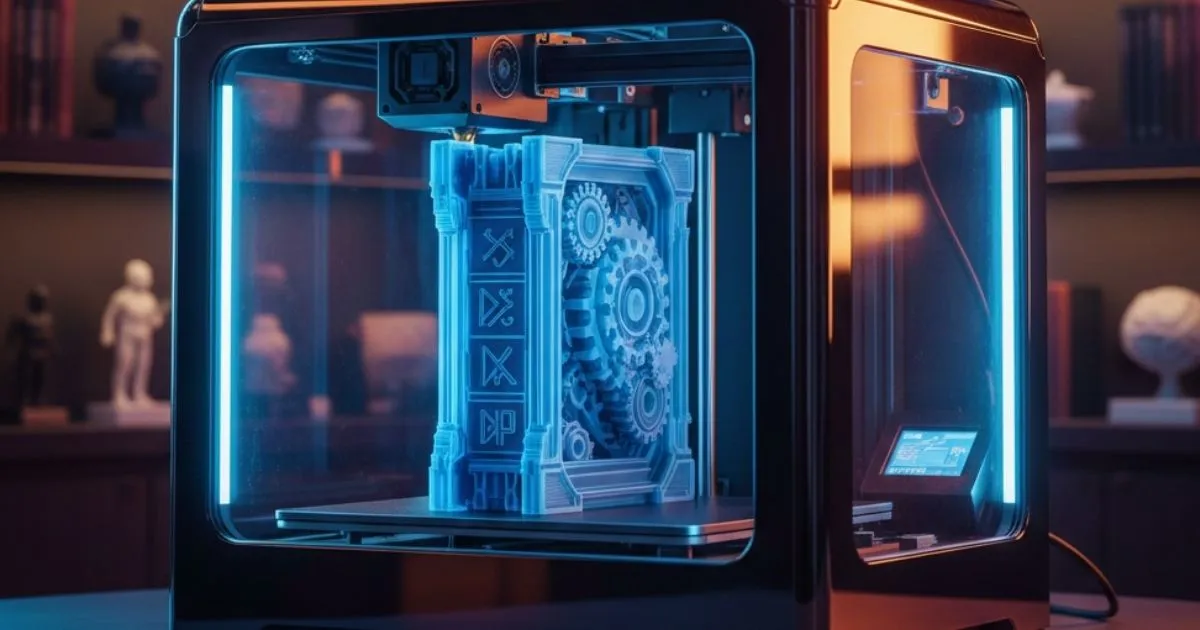
The dusty smell of a used bookstore used to be the only physical link we had to a narrative world, but the air in 2026 smells more like heated resin and curing polymers. I remember sitting in a design studio in Brooklyn last year, watching a translucent, sapphire-colored bust of a protagonist emerge from a vat of liquid. It wasn’t a toy, and it certainly wasn’t a cheap piece of fan merchandise. It was a high-fidelity physical manifestation of a digital soul, a bridge between the ephemeral nature of an e-book and the heavy, undeniable presence of an object you can hold. We are witnessing a quiet but violent shift in how value is perceived in the publishing industry. While the mass market continues its race to the bottom with subscription models that pay authors fractions of a cent, a new class of creators is moving in the opposite direction. They are turning toward 3D Book Printing as a way to reclaim the concept of the “Collectible,” and in doing so, they are rewriting the financial playbook for what it means to be a successful author in the mid-twenties.
The irony of our hyper-digital age is that the more screen-time we consume, the more we crave the tactile. An e-book is a service, a temporary license to view pixels, but a physical object is an asset. For authors, the realization has been stark. You can sell ten thousand digital copies and still feel like a ghost in your own industry. But when you offer a limited, 3D-printed artifact that represents a piece of your world, the economics change. We aren’t just talking about plastic trinkets. We are talking about intricately designed book covers with internal mechanisms, custom-molded slipcases, and even character-based “totems” that ship alongside the text. This is 3D Book Printing reimagined not as a manufacturing hurdle, but as a premium editorial statement. It allows a writer to bypass the traditional gatekeepers of mass production, offering something that feels deeply personal and, more importantly, scarce.
The Economics of Premium POD and the End of Mass Production
The traditional model of publishing was always a gamble of scale. You printed five thousand copies and prayed that the warehouse didn’t become their final resting place. Today, the savvy author looks at Premium POD as a way to mitigate that risk while simultaneously driving up the average order value. I’ve seen independent creators sell “Founder’s Editions” for three hundred dollars a piece, and they sell out in minutes. Why? Because the 3D-printed elements, the textured spines, and the customized tactile feedback of the book make it a one-of-one experience. It is no longer about the information contained within the pages, since that can be found on a Kindle for nine dollars. It is about the ownership of a physical anchor.
From a financial perspective, this shift is revolutionary. By utilizing Premium POD services, authors are essentially running a “just-in-time” luxury brand. They don’t carry inventory. They don’t deal with the heartbreak of remaindered stock. Instead, they focus on the design of the object itself. I spoke with a fantasy writer recently who had integrated 3D-printed “dragon scales” into the binding of her latest release. Each book was slightly different, a result of the additive manufacturing process that allowed for variations in the print run. She wasn’t just a writer anymore, she was a curator of physical art. This is where the money is moving. The middle-class author, long thought to be an endangered species, is finding a new habitat in the high-margin world of bespoke physical goods. It is a more sustainable, more intimate, and frankly, more profitable way to exist in the creative economy.
Crafting Author Merchandise That Actually Matters
There was a time when Author merchandise meant a poorly fitting t-shirt with a book cover slapped on the front. It was an afterthought, a desperate attempt to squeeze a few extra dollars out of a loyal fanbase. But the authors winning in 2026 have realized that merchandise should be an extension of the story, not an advertisement for it. 3D printing has democratized the creation of high-end props. Imagine reading a detective noir and being able to purchase a 3D-printed replica of the mysterious coin found at the crime scene, weighted with internal metallic filaments so it feels real in your palm. This is Author merchandise that functions as a narrative key. It deepens the immersion, making the world of the book feel like a place the reader has actually visited.
The beauty of this approach is the low barrier to entry. You don’t need a factory in another hemisphere to start experimenting with these concepts. Small-scale 3D printing farms are popping up everywhere, acting as local nodes for this new kind of publishing. I’ve noticed that the most successful projects are the ones that lean into the “idiosyncrasies” of the medium. They aren’t trying to look like mass-produced plastic. They embrace the layer lines, the unique textures of recycled filaments, and the architectural complexity that only 3D printing can achieve. It creates a sense of “lived-in” authenticity that mass production can’t touch. When a reader buys these items, they aren’t just buying a product, they are buying a piece of the author’s vision that has been pulled from the digital void and solidified into reality. It’s a powerful psychological hook that builds a level of brand loyalty most corporate publishers would kill for.
In the end, we are moving toward a future where the digital version of a book is the introduction, and the physical, 3D-printed collectible is the destination. It’s a reversal of the old order. We used to buy the book to get the story. Now, we get the story for free, or nearly free, and we pay for the privilege of owning the artifact. It makes me wonder what our bookshelves will look like in another ten years. Will they be rows of uniform paperbacks, or will they be galleries of strange, beautiful, 3D-printed objects that each represent a journey we’ve taken? The financial incentive is certainly pushing us toward the latter. For the author, it’s a chance to be more than just a name on a screen. It’s a chance to be a maker of things. And for the reader, it’s a chance to hold a piece of the infinite in their hands. The question isn’t whether this technology will change publishing, it’s whether we are brave enough to stop thinking of books as just paper and start seeing them as the center of a much larger, much more tangible universe.

